Why Fast-Paced Reformer Classes Can Make Hypermobility Worse
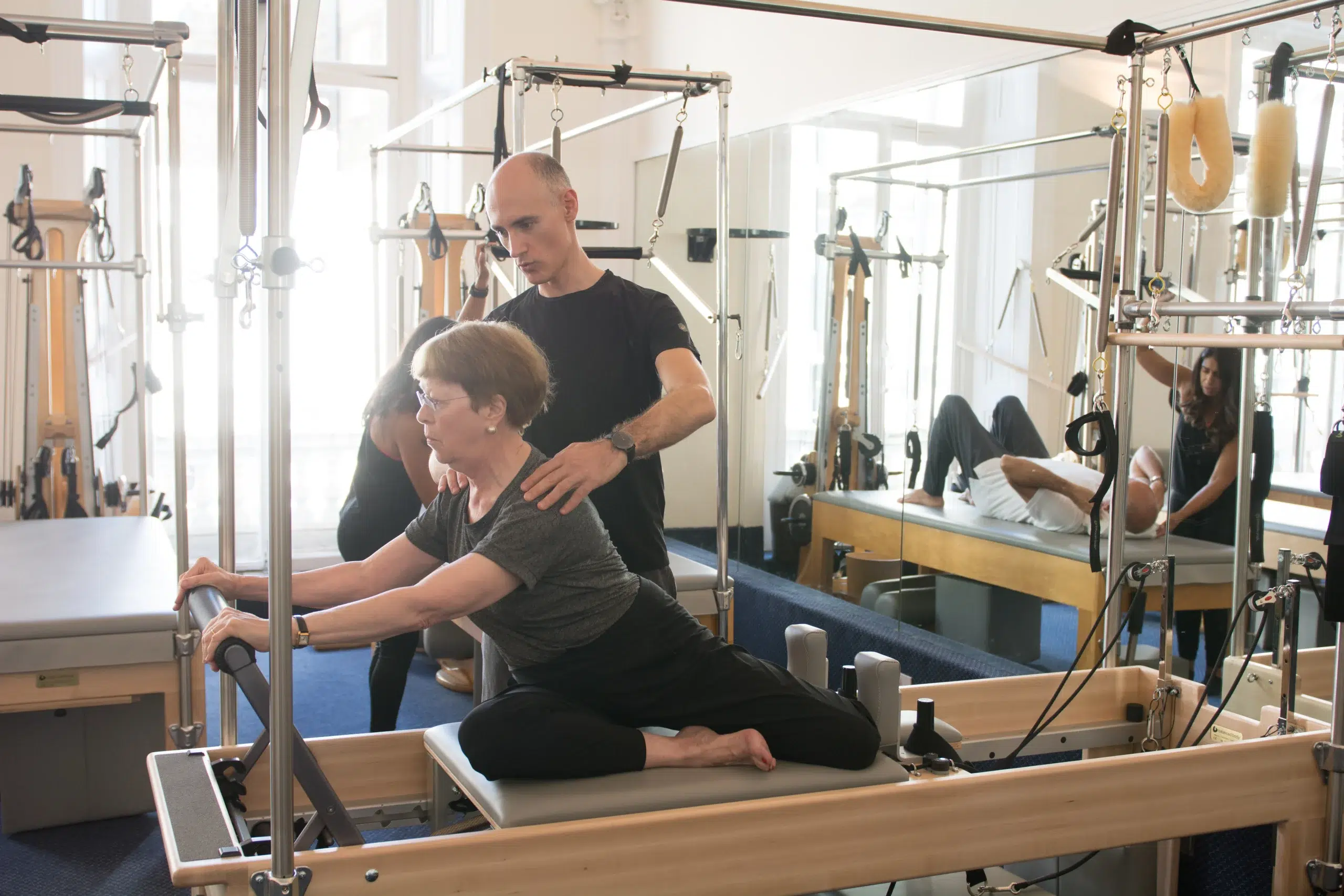


We see a particular pattern quite often at the studio.
A new client arrives — usually younger than most, unusually flexible, and quietly frustrated. They’ve tried several Pilates studios before us. Often multiple times. They were good at it on paper. Teachers noticed their range of movement and praised it. They advanced through exercises quickly. Then, somewhere between the third and fifth week, something would flare up. A shoulder. A hip. The lower back. And they’d leave confused, because Pilates was supposed to be the safe option.
What these clients almost always share is hypermobility.
It’s a condition that makes people look like ideal Pilates candidates. In reality, without the right approach, it makes them vulnerable in ways that standard classes — and particularly the fast-paced reformer studios that have proliferated across London in recent years — are often not equipped to manage.
Hypermobility refers to joints that move beyond their normal range. The underlying cause is usually laxity in the connective tissue — the ligaments, tendons and fascia that give joints their stability.
For many people this is mild and asymptomatic. For others it presents as part of a broader picture, including conditions such as hypermobile Ehlers-Danlos Syndrome (hEDS) or hypermobility spectrum disorder (HSD), which can involve chronic pain, frequent injury and significant fatigue.
The critical distinction — one that is often misunderstood in fitness settings — is that flexibility is not the same as stability. A hypermobile joint can move impressively through range, but the muscles around it may have very little control at the end of that range. The joint is not strong there. It is simply loose.
That difference matters enormously when it comes to exercise selection, load and pacing.
For more information on hypermobility spectrum conditions, the Ehlers-Danlos Society and the NHS both provide clear, reliable overviews.
The attraction makes sense.
Pilates has a genuine, well-established reputation for rehabilitation. It is lower impact than gym training. It emphasises control and alignment. For someone dealing with recurring injuries or unstable joints, it sounds precisely like what is needed.
And hypermobile individuals often do well in the early weeks. Their range of motion is impressive. Instructors notice them. They can access positions that other students work towards for months. There is an understandable sense of being naturally suited to the method.
This early advantage is, unfortunately, part of the problem.
Because what looks like skill is often the body travelling through range it cannot truly control. The deeper stabilising muscles — the ones Pilates is designed to build — are not doing their job. Instead, the joints are doing what they always do: moving further than they should, relying on passive structures rather than active muscular support.
Without an experienced instructor who understands this, the hypermobile client will keep being asked to push into that range. And the instability quietly compounds.
This is where the recent trend in Pilates creates a genuine difficulty for hypermobile clients.
The proliferation of high-intensity, fast-paced reformer studios has changed what many people understand Pilates to be. These studios are visually impressive, socially compelling and commercially successful. They are not, for the most part, doing anything dishonest. But they are built around a model — group sessions, continuous movement, short rest periods, instructor-to-client ratios that make individual monitoring impossible — that is poorly matched to the needs of unstable joints.
Several specific issues arise:
Momentum replaces control. In a faster-paced class, exercises flow one into the next. The client does not have time to reset alignment, check in with what they are feeling, or ensure each repetition is genuinely controlled. For a hypermobile joint, momentum through end range is where damage accumulates.
Fatigue reduces alignment awareness. As a session progresses and muscles tire, the body’s ability to maintain joint position degrades. In a standard client this creates minor compensation patterns. In a hypermobile client it can allow joints to collapse into positions they were never meant to sustain under load.
Group settings prevent proper observation. A skilled instructor in a one-to-one setting will notice the moment a client’s knee drifts inward, or the subtle hitch in a shoulder that signals something is not tracking correctly. In a class of ten or twelve people moving at pace, those micro-signals are invisible. The client receives general cues, not the specific ones they actually need.
Repetitive end-range movement creates cumulative stress. The reformer, used well, is an extraordinary piece of apparatus. It provides resistance, supports posture, and allows for extraordinary precision. But in a high-repetition, end-range format with hypermobile clients, it becomes something that repeatedly loads the loosest point of already-unstable joints. Over time, the surrounding tissue responds — not by strengthening, but by becoming more irritated and inflamed.
Excessive stretching compounds the problem. Many fitness-based Pilates classes still celebrate flexibility as the goal. For hypermobile clients, more stretch is almost always the wrong direction. What they need is less range and more strength at the range they already have.
Is reformer Pilates good for hypermobility? Reformer Pilates can be beneficial for hypermobile clients, but only when delivered slowly, individually and by an instructor with rehabilitation experience. Fast-paced group reformer classes often aggravate hypermobility by prioritising range and repetition over joint control and alignment.
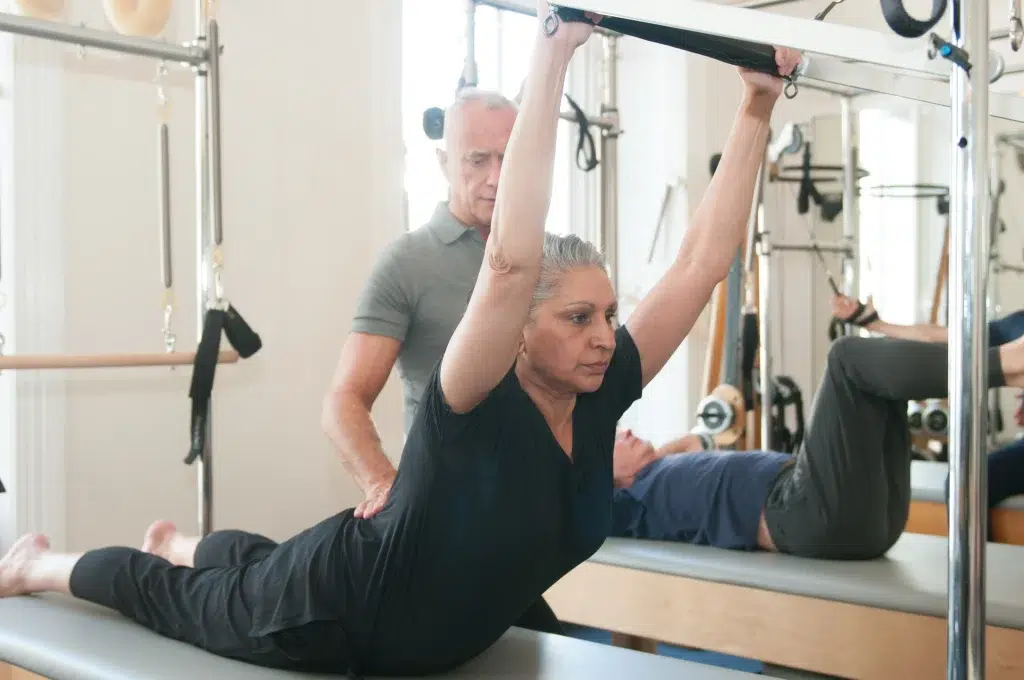
When we work with hypermobile clients at the studio, the approach looks quite different to what they are usually expecting.
The pace is slower. Sessions involve fewer exercises, not more. There is significant time spent on what might look like very small adjustments — the position of a heel, the degree of rotation in a hip socket, the engagement pattern in a deep abdominal. None of this is wasted.
The reason is proprioception. Hypermobile bodies often have impaired proprioceptive feedback — the nervous system’s ability to sense joint position. This is one reason injuries occur: the body simply does not register that a joint has moved into a dangerous position until it is too late. Slow, technical movement trains this feedback system directly. You cannot rush it.
Breath control plays a central role here too. Correct breathing mechanics engage the deep stabilisers of the spine and pelvis — the muscles that protect joints during movement. In fast-paced classes, breathing tends to be deprioritised or used simply as a rhythm cue. In precision-based Pilates, it is structural.
Joseph Pilates’ original method was always built around this principle. The method was not designed to exhaust the body. It was designed to reorganise it — to teach the nervous system how to find alignment, load joints appropriately, and move with the minimum effort required. For hypermobile clients, this is not a philosophy preference. It is clinical necessity.
This connects directly to our approach at the studio, which has always prioritised what we call the internal mechanism — the deep structural work that standard fitness instruction tends to skip entirely.
This is worth naming clearly, because many hypermobile clients leave sessions feeling that something is wrong but cannot pinpoint why.
The following are common patterns we hear described:
None of these are signs that the person is weak or difficult to train. They are signs that the approach needs to change.
If you are hypermobile and looking for Pilates instruction in London, the quality of the studio and its instructors matters far more than the equipment list or the aesthetic of the space.
Practically, it is worth asking:
Is there an individual assessment before you begin? Any studio serious about rehabilitation should be mapping your structure, history and movement patterns before designing a session. Generic programmes are not appropriate for hypermobile joints.
Are sessions one-to-one or very small? Proper supervision of a hypermobile client in movement requires an instructor whose full attention is on you. Group reformer classes, however experienced the teacher, cannot provide this.
Does the studio understand rehabilitation? Not all Pilates instruction is rehabilitation-informed. Look for studios where teachers have trained extensively in working with specific conditions — not studios where teachers have completed a weekend course and moved on to cueing aesthetic positions.
Does the language lean toward control, or toward pushing harder? The culture of a studio is usually apparent quickly. Instruction that consistently celebrates greater range, higher intensity or faster pace is not the environment a hypermobile client needs.
For those searching specifically for hypermobility Pilates in London, it is worth prioritising studios with a long-established rehabilitation focus over newer fitness-format studios, however well-reviewed they may be for the general population.
We have worked with hypermobile clients throughout our forty-plus years at the studio. They are among the clients who benefit most profoundly from the method — when it is applied correctly.
What that means in practice is an initial individual assessment that looks specifically at joint mobility patterns, identifies where instability exists, and maps the exercises and progressions most appropriate for that person’s structure. For hypermobile clients this is not a formality. The assessment findings shape every decision that follows.
Sessions are conducted one-to-one, using the full classical apparatus. Spring resistance is selected deliberately — not to push range, but to provide feedback and load the stabilising muscles in positions that matter. Where most fitness-based instruction asks “how far can you go?”, our question is “how well can you control the middle of that range?”
Progress looks different too. A hypermobile client’s success is not measured in deeper stretches or more complex sequences. It is measured in joints that stop flaring up. In a lower back that no longer compresses. In a hip that moves without the catch it had for years. In the ability to move through a full day without managing pain as a background condition.
These are the outcomes that bring clients back to the studio — not for weeks, but for years. Some of our longest-standing hypermobile clients have been working with us for a decade or more. The relationship between the teacher, the method and the individual body takes time to build. But when it does, the results hold.
If you are hypermobile and uncertain whether Pilates has anything to offer after previous experiences have not gone as hoped, we would encourage you to speak to us before writing it off. What you may have experienced before was not precision-based Pilates. It was fitness instruction delivered under the Pilates name.
The difference, for a hypermobile body, is significant.
Trevor Blount Pilates is based in South Kensington, London. We offer individual assessments and one-to-one sessions for clients with hypermobility, rehabilitation needs and long-term movement goals. To find out more about our method or to arrange a consultation, get in touch with the studio.
