

Parkinson’s disease affects movement in ways that are highly individual — the tremor that dominates one person’s experience may be barely present in another’s, while rigidity, slowness and balance difficulties can shift from week to week. This is precisely why generalised exercise classes often fall short for people managing Parkinson’s, and why the one-to-one format has always felt like the only honest way to work.
In over 40 years of practice, I’ve worked with clients at every stage of Parkinson’s. What I’ve consistently found is that the qualities built into classical Pilates — unhurried movement, breath awareness, deliberate precision — are exactly what Parkinson’s asks for. The disease tends to speed the body up in ways it doesn’t want to go. Pilates, by design, slows everything down.
Is Pilates Good for Parkinson’s Disease?
Yes. Pilates is well-suited to Parkinson’s disease because it addresses several of the condition’s core movement challenges: balance and postural instability, rigidity, reduced range of motion and the loss of confident, fluid movement. Research published in Medicina concluded that Pilates can be safely prescribed for people with mild-to-moderate Parkinson’s, with evidence of improvements in fitness, balance and physical function — and notably, that its benefits for lower-limb function appear superior to those of conventional exercise programmes.
What clinical studies reflect is something we see directly in the studio: when movement is practised slowly, with attention to the body rather than to a beat or a target, people with Parkinson’s find a quality of engagement that hurried exercise doesn’t offer.
How Does Parkinson’s Affect Movement — and Why Does That Matter for Exercise?
Parkinson’s disease is a neurodegenerative condition that gradually affects the brain’s ability to produce dopamine, the chemical responsible for coordinating smooth, controlled movement. The resulting symptoms — tremor, muscular rigidity, bradykinesia (slowness of movement), postural instability and reduced balance — create a pattern where movement becomes effortful and confidence erodes.
For exercise to be genuinely useful, it needs to meet the person where they are. High-impact or fast-paced classes demand a responsiveness the Parkinson’s nervous system often can’t reliably produce. They also risk falls, frustration and the reinforcement of compensatory patterns that make underlying difficulties worse over time.
This is why the assessment comes first, always. Before any movement, I want to understand how your body is currently organising itself: where rigidity is holding, how your balance responds when weight shifts, which postural patterns have developed, and what your body is ready to do safely. From there, sessions are built around what your specific nervous system and musculature need — not a generic programme.
What Can Pilates Help With in Parkinson’s?
Balance and fall reduction. Core engagement and postural control sit at the heart of classical Pilates work. Strengthening the deep stabilisers of the trunk, pelvis and lower limbs builds the physical foundation for steadier standing, walking and turning — movements that often become unpredictable with Parkinson’s progression.
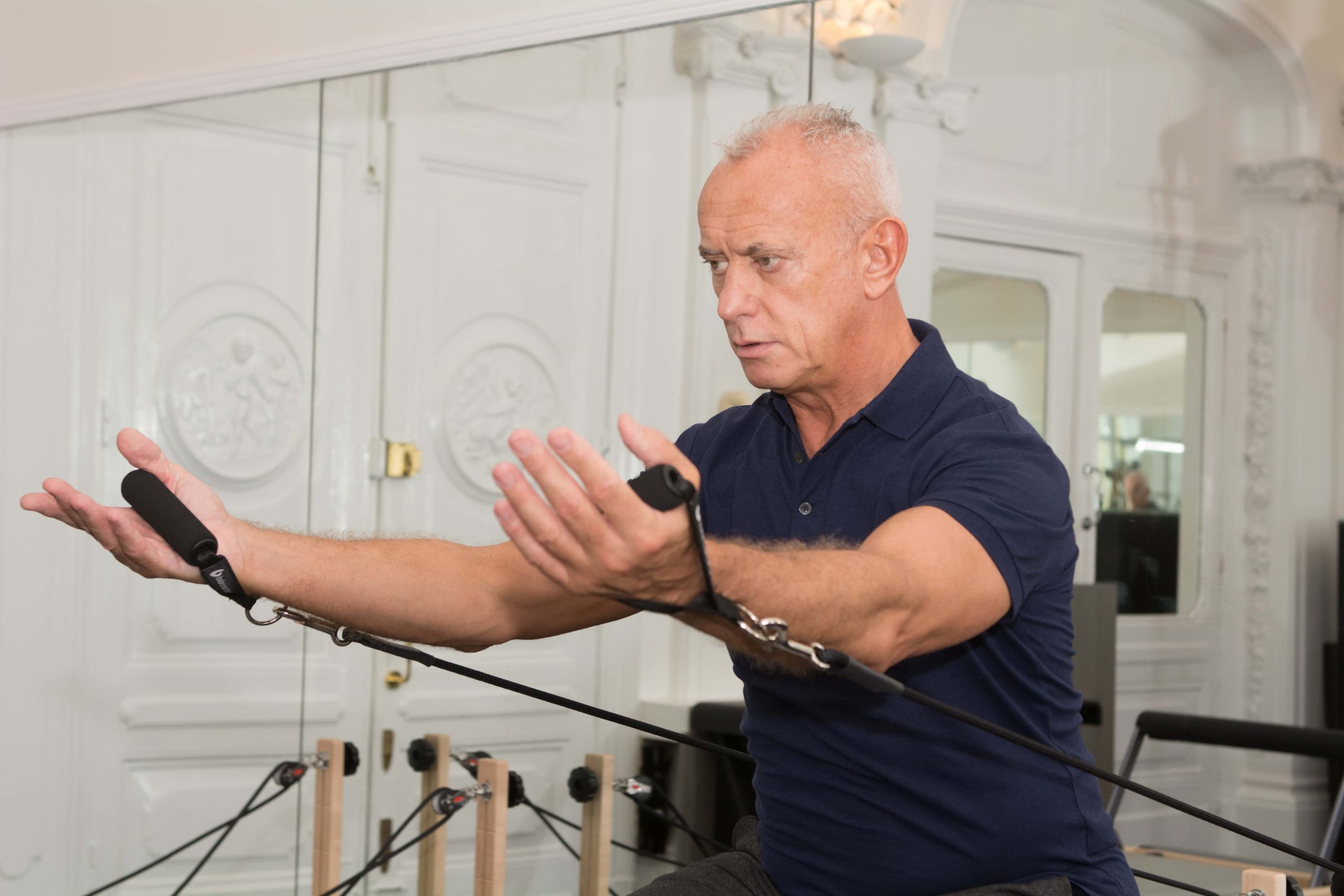
Reducing the effects of rigidity. Controlled mobilisation of the spine, hips and shoulders gradually addresses the muscular stiffness that contributes to the characteristic “frozen” quality of Parkinson’s movement. Work on the apparatus supports this particularly well: the spring-based resistance of the Cadillac and Reformer provides gentle, guided movement through ranges the body resists on its own.
Breathing and relaxation. One of the things I return to most often with Parkinson’s clients is the connection between breath and tension. When breathing becomes shallow and restricted — which Parkinson’s tends to encourage — postural collapse and muscular rigidity compound each other. Reestablishing a full, directed breath changes everything that follows. There’s a reason relaxation sits at the centre of how we work here: athletes at the starting blocks don’t think about the race, they find relaxation. The same principle applies in Parkinson’s rehabilitation.
Slower, more intentional gait. Working with deliberate, sequenced movement patterns can help retrain the nervous system’s approach to initiating and controlling movement. This carries into daily function in ways that matter practically — getting up from a chair, turning without stumbling, descending stairs.
Is It Too Late to Start Pilates with Parkinson’s?
It is not too late. Clients come to us at various stages of Parkinson’s, including those who have been managing the condition for many years. The starting point simply needs to be appropriate to where you are now — and that requires honest individual assessment, not a class template.
It is also worth noting that starting Pilates earlier in the course of the disease, when movement capacity is greater, makes the work easier and builds resilience before difficulties compound. But if you’re coming to it later, there is still meaningful work to be done.
What Is a Typical Session Like for Someone with Parkinson’s?
Sessions take place one-to-one or two-to-one at our South Kensington studio. The pace is always unhurried. There is no music. The intention is that your attention stays with your body throughout — noticing what you feel, how your weight distributes, where things are held. Early sessions will involve significant time on the apparatus in supported positions, building awareness before building load. We work from where you are, not from where a programme says you should be.
If you are already working with a neurological physiotherapist or consultant, we are happy to work alongside that care. We don’t position ourselves as a replacement for medical management — rather, as a complement to it that offers consistent, skilled one-to-one or two-to-one attention over time.
For an overview of how our approach differs from mainstream Pilates, see Our Method.
If you or someone you care for is managing Parkinson’s and considering whether Pilates might help, get in touch. The first conversation is always straightforward.
