

Scoliosis is one of those conditions that people carry for years, often decades, without ever having received much in the way of practical guidance about how to live and move with it. The diagnosis may have come in adolescence, or it may have emerged gradually in adulthood as part of degenerative spinal change. Either way, the question that brings most people to us is the same: can Pilates actually help?
The honest answer is: meaningfully yes, with some important qualifications.
Can Pilates Help with Scoliosis?
Yes. Pilates cannot reverse or cure scoliosis — a structural lateral curvature of the spine — and it is important to be clear about that. What it can do, consistently and significantly, is strengthen the muscles that support the curved spine, improve body awareness and postural control, reduce pain and tension associated with the asymmetrical muscular loading that scoliosis creates, and improve breathing mechanics that the rib cage distortion of scoliosis can compromise.
For adults with scoliosis — particularly those whose curves are mild to moderate and who are not candidates for surgery — this represents meaningful improvement in daily quality of life. Clients who have worked with us over years report less pain, better posture and greater confidence in movement. That is a realistic and valuable outcome.
What Is Scoliosis?
Scoliosis is a three-dimensional spinal condition characterised by an abnormal lateral curvature and rotational component. When viewed from behind, the scoliotic spine appears to curve sideways — either in a single “C” curve or a double “S” curve. But the rotation of the vertebrae within the curve is equally significant: it changes the shape of the rib cage, affects the muscles on either side of the spine asymmetrically, and alters the way load is distributed through the spine in everything from sitting to walking.
The most common type — idiopathic scoliosis — has no clearly identified cause and accounts for roughly 80% of cases. It is typically diagnosed in childhood or adolescence. Degenerative scoliosis develops in adults as part of the ageing process, often presenting from midlife onward. Both types benefit from the same Pilates principles, though the starting point and progressions differ.
How Do You Know What Type of Scoliosis You Have?
A confirmed scoliosis diagnosis requires an X-ray measured by the Cobb method. The Cobb angle gives a numerical measure of the curve’s degree and, therefore, its severity. A curve of 10 degrees meets the clinical threshold; curves above 40 degrees are generally considered more significant. If you’ve been told you have scoliosis based on a visual assessment or surface examination, please confirm this with imaging before beginning any exercise programme specific to scoliosis.
Why Is One-to-One Pilates Important for Scoliosis?
No two scoliotic spines are identical. The curve pattern, the direction of rotation at the apex, the compensatory patterns that have developed, the presence or absence of pain — all of these vary between individuals. This means that exercises beneficial for one person’s scoliosis may be contraindicated for another’s.
In a group class, this level of individualisation is not possible. In a one-to-one session, I can assess where your spine is holding compression, where the concavities need opening, which muscles are working too hard on one side and not enough on the other — and build a session that addresses your spine specifically.
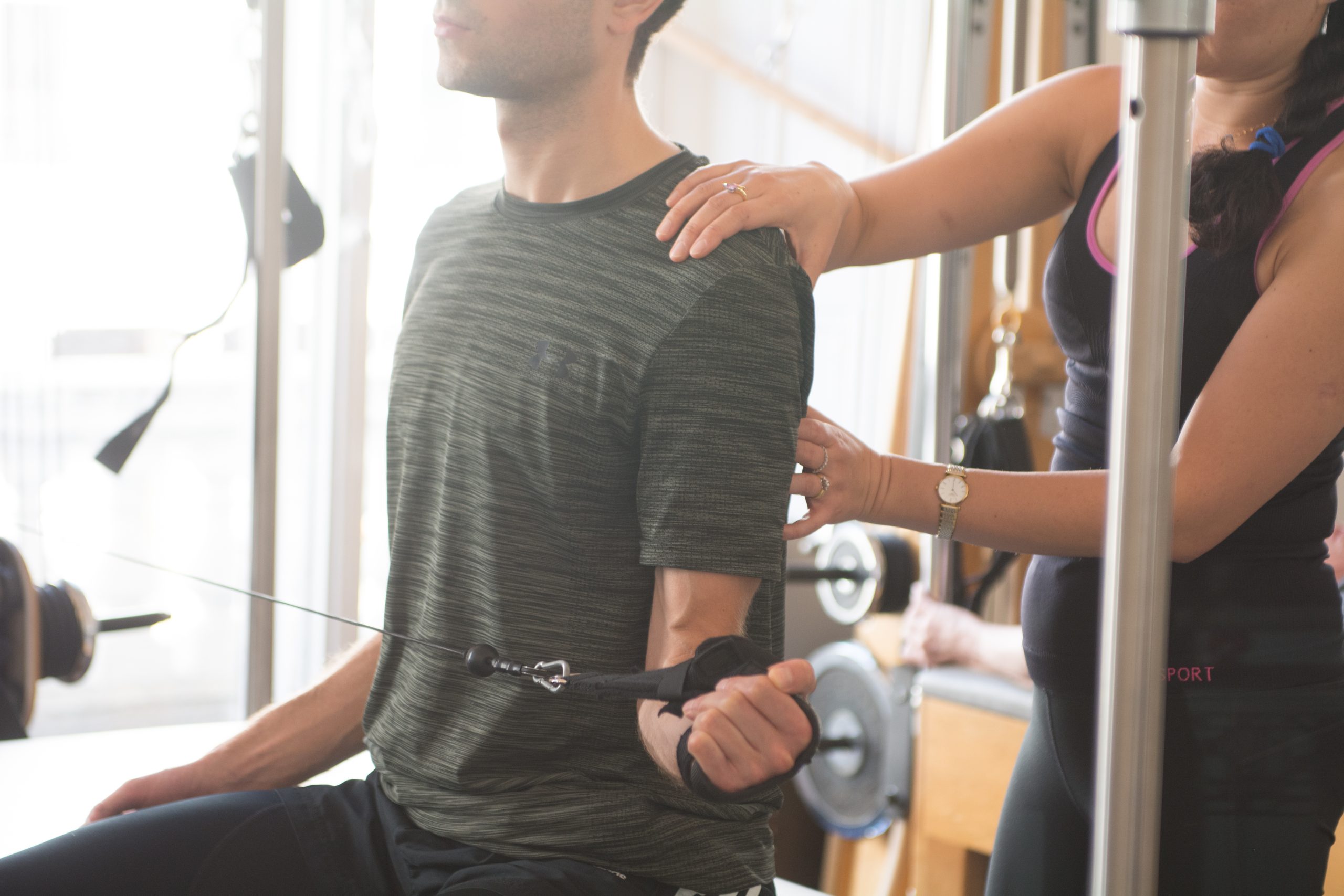
The classical Pilates apparatus is particularly useful here. The Cadillac, Reformer, and Ladder Barrel allow supported positions that reduce the compressive effects of gravity — which, for scoliosis, can perpetuate the collapse of the concave side of the curve. The apparatus also allows us to work in asymmetric ways when appropriate, addressing the specific pattern of your curve rather than treating the spine as symmetrical.
What Does Pilates for Scoliosis Focus On?
Axial elongation. The first priority is teaching the spine to decompress and lengthen along its own central axis. This means working against the gravitational compression that scoliosis exacerbates, opening the concave sides of the curve using breath and directed awareness.
Breath directed into restricted areas. The rib cage distortion that accompanies spinal rotation can significantly restrict breathing on the compressed side. Directed breath — using the breath deliberately to expand specific areas of the rib cage — is both a therapeutic tool and a diagnostic one. Where the breath goes tells us what is holding.
Deep stabiliser strength. The deep spinal muscles that run along the sides of the vertebrae behave asymmetrically in scoliosis — overshortened on one side, overlengthened on the other. Building balanced strength in these muscles, without simply reinforcing the existing asymmetry, requires careful exercise selection and consistent monitoring.
Postural awareness in daily function. Scoliosis management in Pilates is not only about what happens in the studio. It is about building enough awareness and muscular support that the posture you practise in sessions begins to carry over into how you stand, sit and move through the rest of your day.
Should You Avoid Any Exercises with Scoliosis?
This depends entirely on your curve pattern and severity. Some rotation exercises are appropriate and beneficial for certain scoliosis types; others would increase the rotational component of the curve and are best avoided. Spinal flexion work — roll-ups, C-curves — may be modified or excluded depending on the configuration of the curve. This is precisely the kind of decision that requires assessment, not assumption.
Is There Any Research Supporting Pilates for Scoliosis?
Research in this area is more limited than for some other conditions, but existing studies report improvements in Cobb angle, postural balance, pain and quality of life in adults with scoliosis following Pilates-based programmes. The most clinically consistent finding is not curve correction — which in structural adult scoliosis is unrealistic — but meaningful improvement in function, pain levels and muscular symmetry. This matches what we observe over time in clients who work consistently.
Scoliosis shares characteristics with hypermobility in terms of the need for precision in exercise selection and the risks of unmodified generic training. For further context on working with complex spinal presentations, see Pilates for Hypermobility.
If you have scoliosis and are considering whether Pilates could help, the most useful next step is a conversation. Contact us at the studio and we can discuss your specific situation and what one-to-one sessions might offer.
