

Most Pilates teacher training in London runs as a group course. You join a cohort, sit through weekend intensives, and work through a shared syllabus alongside a dozen other trainees.
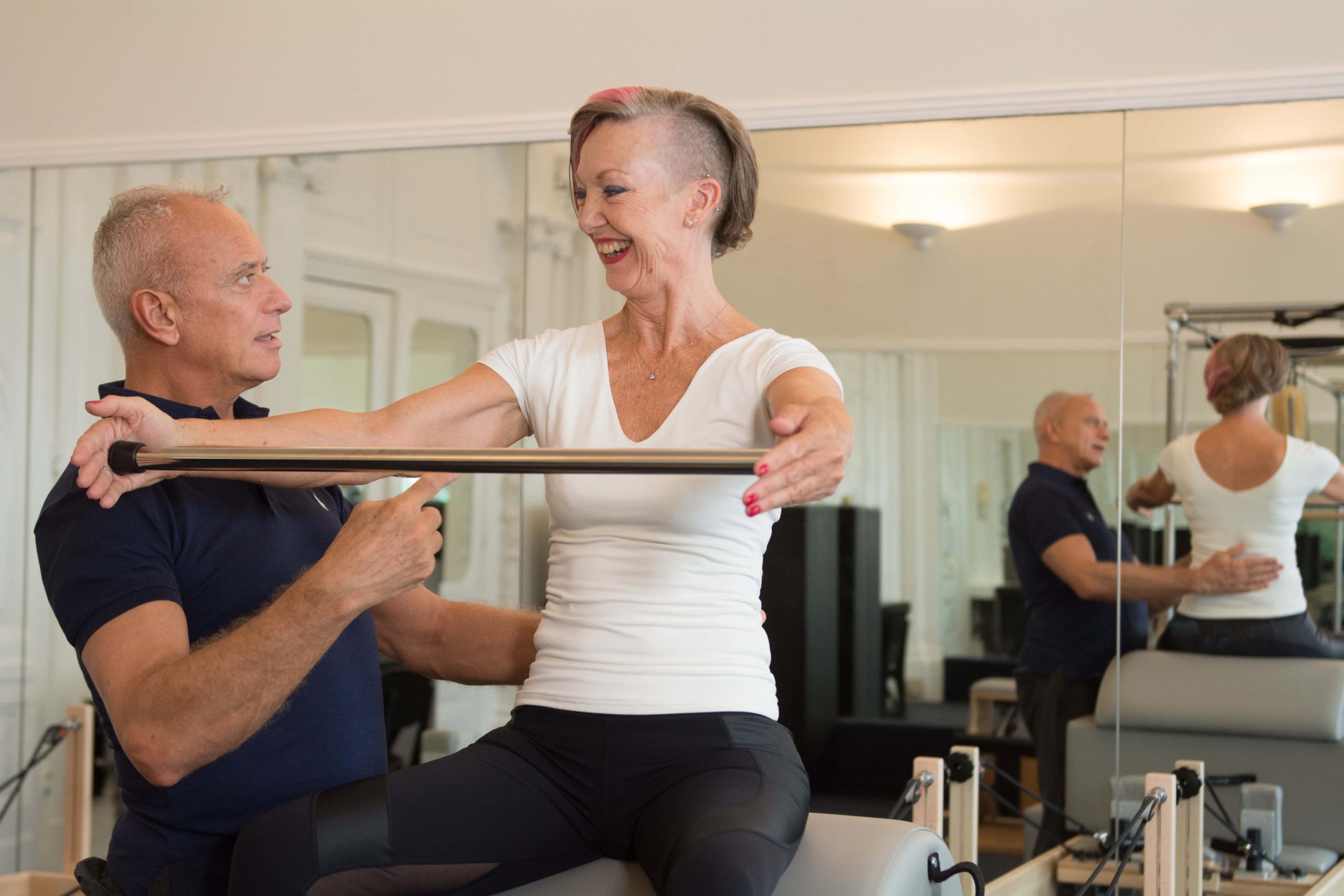
Trevor Blount’s teacher training programme in South Kensington works the opposite way. One student. One teacher. Two years, structured as an apprenticeship rather than a classroom course.
It’s a slower, more demanding path to becoming a Pilates instructor. It’s also, in Trevor’s view, the only way to actually teach the method properly.
A 1,000-Hour Apprenticeship, Not a Weekend Course
The programme has two stages.
Pre-training comes first: 25 to 50 studio sessions completed over six months, alongside an anatomy and physiology certification at the London College of Massage. This is where a trainee builds the foundation before the real training begins.
The training programme itself runs for two years and totals 1,000 hours, split across six terms:
- 325 hours of one-to-one studio sessions, practical training, and lectures
- 500 hours of supervised teaching practice in the South Kensington studio, working with real clients under Trevor’s direct guidance
- 150 hours of home study and coursework
- 25 hours of specialist training in remedial exercise for injury rehabilitation and common conditions
The final term is largely devoted to examination preparation: coursework, a self-assessment, two case studies, and a practical exam.
For context, that’s a substantially longer and more hands-on commitment than most UK Pilates certification courses, which typically run a few hundred hours across mat work alone.
Why One-to-One Instead of a Classroom
The apprenticeship model isn’t a stylistic choice. It comes directly from how Trevor teaches Pilates itself.
Trevor’s method centres on what he calls the “internal mechanism” of an exercise: learning to sense what your body is actually doing, rather than following an instructor’s cues by rote. That’s difficult to teach in a group setting, where an instructor is watching ten bodies at once. It’s much easier to teach when the training itself happens one-to-one.
So trainees don’t just learn Pilates exercises. They spend hundreds of hours watching Trevor work with real clients — including people recovering from surgery, managing chronic conditions, or dealing with hypermobility — and then teaching under his direct supervision. The goal isn’t to memorise a repertoire. It’s to develop the same eye for individual anatomy and limitation that the studio’s whole approach is built on.
Training on the Full Classical Apparatus
Many Pilates instructor courses in London focus on mat work, or mat plus reformer. Trevor’s programme covers the complete classical apparatus:
- Reformer
- Cadillac
- Wunda Chair
- Ladder Barrel
This matters for anyone planning to teach in a studio environment rather than run mat classes. It’s also closer to how Joseph Pilates originally taught the method, using the full range of equipment rather than a narrowed-down modern subset.
Built on 40 Years of Teaching, and a Role in Shaping the Profession
Trevor didn’t design this course as a first attempt at training instructors. He’s been teaching Pilates for over 40 years, and teacher training has been part of his work for more than 30 of them.
In 1996, he was one of the founding members of the PILATESfoundation, the UK’s professional body for Pilates teachers. He was also instrumental in building the Foundation’s teacher training accreditation system, established in 1999 — the framework that much of UK Pilates certification is still built on today.
In 2010, he began offering this comprehensive certification programme directly to his own students in South Kensington, drawing on decades of both teaching Pilates and training other teachers to do the same.
Who the Programme Is For
Applicants don’t need a dance or bodywork background, though it can help. What’s required is a genuine understanding of Pilates and a clear reason for wanting to teach it.
The application process starts with a CV outlining any Pilates experience, along with a letter explaining why you want to become a Pilates teacher. Successful applicants are then invited to a session with Trevor at the studio, followed by a conversation about their suitability for training and what the programme involves.
Given the one-to-one structure, places on the programme are limited by nature. Trevor can only train one student at a time within any given period.
Find Out More
Full details on the application process, course structure, and how to get started are on our Pilates Teacher Training page.
