

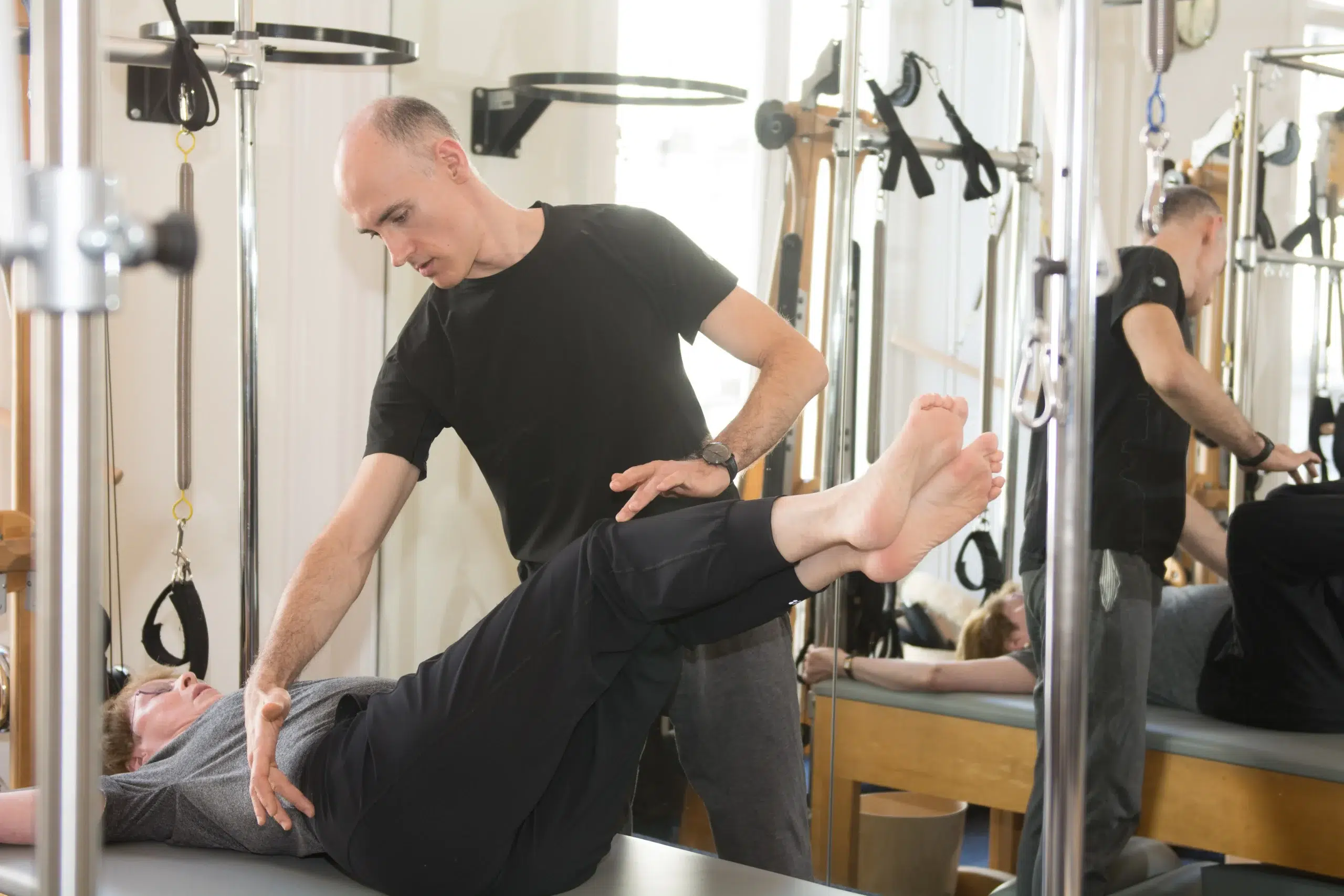
The weeks following hip replacement surgery tend to raise a consistent set of questions.
When is movement safe again? How quickly should strength return? Which exercises help and which carry risk? And — for those already familiar with Pilates, or considering it for the first time — is it appropriate to return to, or to begin, a Pilates programme during recovery?
The short answer is yes, in most cases, and often to considerable benefit. The longer answer involves timing, surgical specifics, and the type of Pilates instruction involved — because not all approaches to movement rehabilitation are equally suited to post-surgical recovery.
This article addresses what patients and their families most commonly need to know before returning to exercise after hip replacement surgery.
Can You Do Pilates After a Hip Replacement?
For most patients, Pilates is not only possible after hip replacement surgery — it is one of the more appropriate forms of exercise available during the later stages of recovery.
The reasons are practical. Pilates, at its core, focuses on low-impact strengthening, controlled range of motion, pelvic stability, and precise postural alignment. These are exactly the qualities that hip replacement rehabilitation requires. The method places minimal load on the new joint while systematically addressing the muscular weaknesses and movement compensations that commonly develop both before and after surgery.
That said, timing is everything. Any return to structured exercise after hip replacement — including Pilates — should be cleared by the treating surgeon or physiotherapist first. The appropriate starting point varies considerably depending on:
- Whether the procedure was a total or partial hip replacement
- The surgical approach used — anterior (front) and posterior (rear) approaches carry different movement restrictions in the early recovery period
- The patient’s age, general health, and mobility before surgery
- Whether there were any complications during or after the procedure
A broad general guide is that formal rehabilitation-focused Pilates can begin somewhere between six and twelve weeks post-surgery for most patients, once initial wound healing is complete and basic mobility has been established. Earlier than this, work should remain with the physiotherapy team and focus on prescribed exercises, walking, and gentle daily movement.
Is Pilates safe after hip replacement surgery?
In most cases, yes — Pilates is well suited to hip replacement rehabilitation, particularly assessment-led, one-to-one sessions that can be adapted to the individual’s surgical history and current recovery stage. It is low-impact, easily adapted to individual restrictions, and directly addresses the muscular and postural demands of recovery. Clearance from a surgeon or physiotherapist is essential before starting, and the type of instruction matters enormously — one-to-one assessed sessions are not the same as a group reformer class.
Why Pilates Works Well for Hip Replacement Rehabilitation
Hip replacement surgery addresses the joint itself. What it does not address — and what rehabilitation must — are the secondary consequences of living with a deteriorating hip before surgery, and the compensations the body builds around a new joint as it learns to trust it.
Most patients arrive at surgery having spent months, sometimes years, managing pain. In that time the body will have shifted load away from the painful hip — altering gait patterns, recruiting the wrong muscles, and creating imbalances that become deeply habituated. The joint may now be repaired, but the movement patterns that developed around the pain remain.
Pilates is well suited to addressing this because of how methodically it approaches movement. Specifically, for hip replacement recovery, the method offers:
Pelvic stability work. The muscles around the pelvis — particularly the deep hip stabilisers and glutes — frequently weaken both before and after surgery. Restoring their function is central to recovering walking mechanics and protecting the new joint from uneven loading.
Controlled range of motion. Pilates exercises can be precisely calibrated to work within the safe range for each patient’s surgical approach. Unlike many forms of fitness exercise, the range and load are easily modified session by session as recovery progresses.
Balance and proprioception training. After hip replacement, the body’s sense of joint position — proprioception — is often temporarily impaired. Pilates emphasises exactly the kind of slow, attentive movement that rebuilds this awareness most effectively.
Gait re-education. Many patients develop a subtle limp or compensatory walking pattern that can persist long after the joint has healed, if left unaddressed. Pilates work on postural alignment, hip extension, and glute activation directly supports the restoration of natural walking mechanics.
Breath and deep stabiliser engagement. The deep core muscles — particularly those supporting the lumbar spine and pelvis — are often inhibited by post-surgical pain and guarding. Breathing work that engages these muscles creates a stabilising foundation before more demanding exercises are introduced.
The spring-loaded apparatus used in classical Pilates is particularly useful here. Spring resistance can support the leg during movement, reducing the load on the hip joint while still activating the surrounding musculature. This allows meaningful work to begin well before the patient would be ready for weight-bearing exercises of equivalent intensity.
Can reformer Pilates help after hip surgery?
Yes — when delivered correctly. The reformer’s spring system is particularly valuable in hip replacement rehabilitation precisely because it can assist movement rather than simply resist it. A leg supported by spring tension through a controlled range places far less compressive load on the new joint than the same movement performed against full bodyweight. The key is that sessions must be one-to-one, individually assessed, and progressed carefully — not delivered in a group reformer class format where the instructor cannot adapt to individual surgical restrictions in real time.
When Is It Safe to Start Pilates After Hip Replacement?
When can I start Pilates after a hip replacement?
For most uncomplicated recoveries, rehabilitation-focused Pilates can begin somewhere between six and twelve weeks post-surgery — once the surgeon or physiotherapist has confirmed it is appropriate. Initial sessions focus on breathing, core activation, gentle pelvic mobility and supported glute strengthening. More progressive strength and stability work typically begins from around three months.
Recovery from hip replacement is progressive, and exercise should be too. A broad phased guide below — but these timelines are approximate, and individual variation is significant. Always defer to the guidance of your surgical team.
First Six Weeks
The priority in this period is healing, basic mobility, and the exercises prescribed by your hospital physiotherapy team. Most patients will be working on walking with appropriate support, getting in and out of chairs and vehicles safely, and managing the precautions specific to their surgical approach.
Formal Pilates is not typically appropriate in this phase. The foundation is being established — this is not a period to introduce new movement challenges.
Six to Twelve Weeks
For many patients, this is the window in which carefully adapted, rehabilitation-focused Pilates can begin. Sessions at this stage should focus on:
- Deep breathing and rib cage mobility
- Gentle pelvic floor and deep abdominal activation
- Supported pelvic tilts and small spinal mobility work
- Seated footwork on the reformer at low spring resistance
- Early glute activation work within safe range
Everything in this period should be delivered by an instructor with rehabilitation experience, in a one-to-one setting where exercises can be continuously adapted to the patient’s response.
Three Months and Beyond
From approximately three months, most patients with uncomplicated recoveries can begin more progressive work — building genuine strength and stability in the hip and pelvis, restoring symmetry between sides, and addressing any compensatory patterns that have persisted.
The goal shifts from careful mobilisation to building the long-term physical resilience that allows people to live actively and confidently for years after surgery. This phase benefits from a longer-term commitment rather than a fixed number of sessions.
Useful Pilates Exercises After Hip Replacement
The exercises appropriate for any individual patient depend on their specific situation — the following are illustrative of the kind of work that tends to be useful during various phases of recovery, not a self-directed programme.
Supine breathing and rib expansion — establishes diaphragmatic breath, engages deep stabilisers without loading the hip.
Pelvic tilts — small, controlled movements that restore spinal and pelvic mobility and begin to activate the abdominals and deep hip stabilisers.
Supported bridge work — progressed gradually from small range to fuller hip extension, strengthening the glutes and posterior chain in a supported position.
Side-lying clam variations — targeted hip abductor and external rotator work, adjusted to remain within the safe range for the surgical approach used.
Seated footwork on the reformer — allows controlled glute and quadriceps strengthening with spring support reducing hip load.
Standing balance and hip stability work — introduced once basic strength and confidence have been re-established, targeting the proprioceptive and dynamic stability demands of daily life.
Each of these requires a trained eye to progress safely. What looks simple can easily be performed with the wrong muscles, or in a compensatory pattern that reinforces rather than corrects existing imbalances.
Movements to Avoid After Hip Replacement
What movements and exercises should be avoided after hip replacement?
The specific restrictions depend on the surgical approach used — your surgeon and physiotherapist will provide personalised guidance. However, several categories of movement warrant particular caution, and understanding the distinction between approaches is important:
Deep hip flexion — primarily a posterior approach restriction. For patients who had a posterior (rear) approach, bringing the knee toward the chest beyond 90 degrees is typically restricted in early recovery, as this movement risks dislocation. Crossing the legs at the knee or ankle and internally rotating the operated leg are also contraindicated for this approach. These restrictions are usually temporary and are lifted once the soft tissue has healed and the joint has stabilised.
Active hip extension and external rotation — primarily an anterior approach restriction. The direct anterior approach has become increasingly common and is considered muscle-sparing, but it carries its own early restrictions: active hip extension and external rotation (such as a figure-four position) should typically be avoided in the early weeks. Many anterior approach patients now leave hospital without formal hip precautions, but this varies by surgeon — always confirm what applies to your specific procedure.
The key point: restrictions are approach-specific. What applies to a posterior approach patient does not necessarily apply to an anterior approach patient, and vice versa. This is one of the primary reasons unsupervised online programmes are unsuitable for post-surgical rehabilitation — they cannot account for the approach used.
Aggressive stretching of the hip. Stretching toward end-range positions is not appropriate until the joint has stabilised and surrounding tissue has healed. Stretching too eagerly too soon is one of the most common rehabilitation errors, and one that is easily made in fitness-format classes where flexibility is still treated as a goal.
Twisting movements under load. Rotating the pelvis or trunk while the hip is loaded requires careful management. Uncontrolled rotation places asymmetric stress on the new joint.
Fast-paced reformer classes. Group reformer sessions that move at pace, use high repetitions, and do not account for individual surgical histories are inappropriate for patients recovering from hip replacement — at any stage of recovery. The inability to modify in real time for a patient’s specific restrictions makes these environments genuinely risky.
Online or unsupervised programmes. The internet offers no shortage of “Pilates after hip replacement” video content. These are not tailored to your surgical approach, your compensatory movement patterns, or your current recovery stage. They should not replace properly supervised, assessed instruction.
High-impact movement. Running, jumping and any high-impact exercise should be discussed with your surgeon before introduction. For most hip replacement patients, high-impact activity is either permanently restricted or reserved for a significantly later stage.
Why One-to-One Pilates Matters After Surgery
The case for individual instruction after hip replacement is straightforward.
Every hip replacement patient arrives with a different history — different lengths of time living with pain before surgery, different compensation patterns, different surgical approaches, different levels of strength and proprioception going into the procedure. What is appropriate for one patient at eight weeks post-surgery may be premature or unnecessary for another.
Group classes, regardless of how experienced the instructor, cannot account for this variation. The instructor is cuing a group. They cannot simultaneously observe whether one participant’s knee is tracking inward, another is gripping the hip flexors to compensate for weak glutes, and a third is holding their breath through every repetition. These are not subtle errors — they are the precise patterns that, if allowed to consolidate, delay full recovery and reduce long-term outcomes.
In a one-to-one setting, these observations are continuous. Exercise selection, spring resistance, range of motion and pace are adjusted in real time based on what the body is actually doing. This level of attention is not a luxury in post-surgical rehabilitation. It is what makes the difference between consolidating good movement and rehearsing compensation.
Patients who have worked extensively with fitness-format Pilates before their surgery sometimes find the transition to a clinical, assessed approach an adjustment. The pace is slower. There are fewer exercises. Sessions may feel less demanding than expected. This tends to change once the results become apparent — strength that transfers to daily life, a gait pattern that has genuinely corrected, a hip that feels reliable rather than tentative.
Clinical Pilates vs Fitness Pilates After Hip Replacement
Patients searching for Pilates after hip replacement will encounter a wide range of studios and formats. The distinction between clinical Pilates and fitness Pilates is not a marketing preference — it directly affects what is and is not appropriate for post-surgical recovery.
Clinical Pilates is assessment-led. It begins with a detailed evaluation of the individual’s movement patterns, structural history, and current recovery status. Exercises are selected and progressed based on those findings, and the instructor adapts continuously throughout each session.
Fitness Pilates — including most group reformer formats — is built around a standardised programme delivered to multiple participants simultaneously. It is appropriate for a large portion of the healthy population. It is not designed for the specific, graduated demands of post-surgical rehabilitation.
For anyone returning to exercise after hip replacement, this distinction is worth understanding before choosing a studio.
Final Thoughts: Returning to Movement Safely
Hip replacement surgery is, in the vast majority of cases, a genuinely life-improving procedure. The chronic pain that brought the patient to surgery is gone. The joint is new. But the work of restoring full, confident, symmetrical movement — the kind that feels natural rather than managed — happens in the months and years that follow.
Pilates, applied with the appropriate level of expertise and individual attention, is exceptionally well suited to this process. Not because it is gentle — though it is — but because it is precise. It can address the specific muscular weaknesses and movement compensations that remain after surgery, and build the kind of structural strength that lasts.
The approach we take at the studio reflects this. Assessment before programme design. One-to-one attention throughout. Pace and load matched to what the body is actually ready for, not to a generic timeline. Long-term movement quality as the measure of success, rather than how difficult the session felt.
If you are recovering from hip replacement and considering whether Pilates is appropriate for your current stage, the most useful first step is a conversation rather than a class. Get in touch with the studio and we can discuss what your recovery looks like and whether our approach is the right fit. You can also read more about the principles behind our method here.
Recovery is not about returning to where you were before the pain began. It is about moving better than you have in years.
Is walking enough after a hip replacement?
Walking is an important and beneficial part of hip replacement recovery and should be a consistent part of daily activity throughout the process. However, it primarily addresses basic mobility and cardiovascular endurance. It does not systematically rebuild pelvic stability, glute strength, movement symmetry, or the proprioceptive awareness that surgery affects. Structured rehabilitation — including appropriately supervised Pilates — addresses these in ways that walking alone cannot. The two are complementary, not interchangeable.
Trevor Blount Pilates is based in South Kensington, London. We offer individual assessments, two-to-one and one-to-one sessions for clients recovering from hip replacement surgery and other post-surgical rehabilitation needs. To find out more about our method or to speak to the studio about your recovery, contact us here.
