Clinical Pilates vs Fitness Pilates: What Actually Separates Them


The word “Pilates” now covers an enormous range of things.
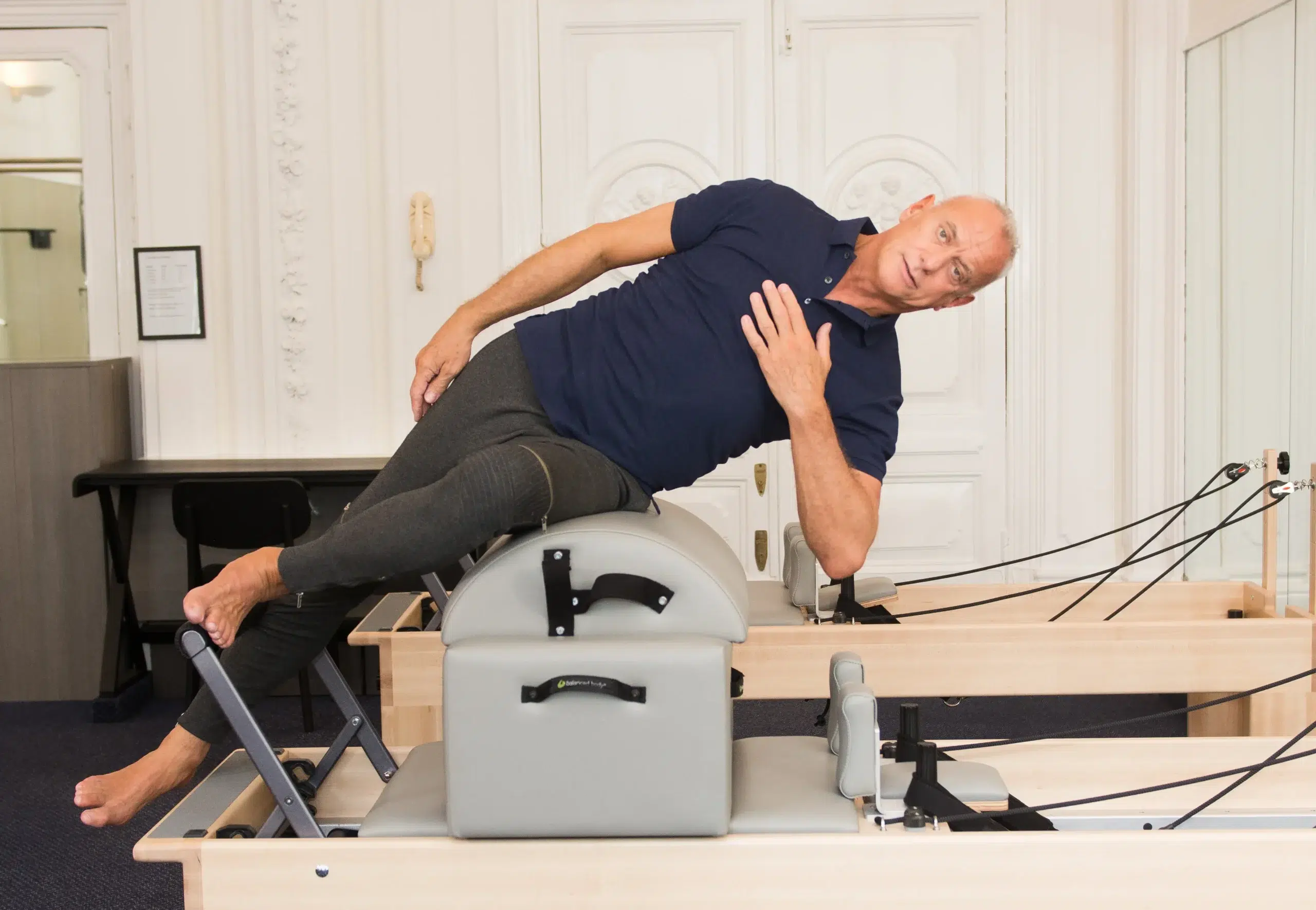
It describes the slow, apparatus-based rehabilitation sessions Trevor has been teaching in South Kensington since 1991. It also describes the high-energy group reformer classes that have expanded across London over the past decade. Both use the Pilates name. Both might use a reformer. The similarities largely end there.
This matters most to people who are not simply looking for general fitness — those dealing with recurring injury, postural dysfunction, pain that hasn’t resolved, or movement problems that standard exercise has not addressed. For this group, the difference between clinical and fitness Pilates is not a matter of preference. It can determine whether the body heals or whether the problem compounds.
This article explains both approaches clearly.
Clinical Pilates is a rehabilitation-informed application of the Pilates method. The word “clinical” signals that the approach is grounded in movement assessment, anatomical understanding, and individual adaptation — rather than general fitness conditioning.
At its core, clinical Pilates begins with an evaluation of the individual’s movement patterns, structural asymmetries, postural alignment and any injury or dysfunction history. Nothing is assumed. The session design follows from that assessment.
Exercises are selected for their specific effect on the client’s body. Pace is slower. Precision is valued over repetition. The instructor is observing continuously — checking alignment, identifying compensation patterns, adjusting load and resistance based on what they see.
This approach is not limited to people with injuries. It is, however, the most appropriate method for anyone whose movement has been shaped by injury, surgery, chronic pain, postural problems or conditions that affect joint stability.
The term “therapeutic Pilates” is also used to describe this approach. The meaning is broadly the same: Pilates delivered with a rehabilitation-first mindset, usually by instructors with specific training in working with dysfunction and injury.
Fitness Pilates prioritises conditioning. The goal is improved core strength, general mobility, cardiovascular fitness and body composition, delivered in a format accessible to a broad range of people.
Group reformer studios represent the most visible form of fitness Pilates today. Sessions are typically structured around class formats — a set sequence of exercises, usually performed at pace, with the instructor cuing the group through transitions. The environment tends to be energetic. Repetition and intensity are seen as markers of a productive session.
This format works well for a large portion of the population. For people who are generally healthy, structurally sound and simply looking to move more, build core strength or find a low-impact complement to other training, fitness Pilates delivers real value.
The distinction worth understanding is this: fitness Pilates is designed around the average body. Clinical Pilates is designed around your body.
The reformer is a piece of equipment. Whether a session using it qualifies as clinical or fitness Pilates depends entirely on how it is taught, by whom, and with what level of individual attention.
The table below addresses the methodological differences — not the equipment:
| Clinical / Rehabilitation Pilates | Fitness / Group Reformer Pilates | |
|---|---|---|
| Starting point | Individual movement assessment | Standardised class format |
| Session design | Built around each person’s structure | Built around a group programme |
| Pace | Slow, deliberate | Faster, flowing |
| Instructor focus | Continuous individual observation | Group instruction and general cuing |
| Goal | Restore function, address dysfunction | Conditioning and general fitness |
| Exercise selection | Based on structural findings | Based on class format |
| Progress measure | Improved movement quality and pain reduction | Increased strength, endurance, range |
| Class size | One-to-one or very small | Typically eight to fourteen |
Neither column is inherently superior. They serve different purposes. The mismatch happens when someone who needs the first column ends up in the second — usually because they did not know the difference existed.
Two people can present with identical symptoms — chronic lower back tension, for instance — and have entirely different structural causes. One may have a long-standing pattern of lumbar hyperextension caused by hip flexor tightness. Another may have excessive posterior pelvic tilt and underactive gluteals. Both say their back aches. The exercises appropriate for each person are not the same.
This is why assessment is not an optional step in rehabilitation-informed Pilates. It is the foundation the entire programme rests on.
Without it, exercises are selected on a generic basis. The instructor is working from a category — “back pain” — rather than from the specific pattern in front of them. For some clients this still produces results, because the category applies broadly enough. For others it does nothing. For a smaller group, particularly those with structural asymmetries, hypermobility or compensation patterns established over years, generic programming can actively reinforce the problem.
Assessment examines what is actually happening in the body: where compression is occurring, what compensation patterns have developed, which muscle groups are underperforming and which are overloading as a result. From that picture, a programme emerges that targets the specific dysfunction — not the symptom that brought the client through the door.
This is the distinction that separates rehabilitation Pilates from fitness Pilates most clearly: not the equipment, not the pace, but the question it starts from.
Yes — and this distinction is worth being precise about, because reformer Pilates has become synonymous with the fitness format in the public mind. The reformer itself is not inherently a fitness tool.
Joseph Pilates designed the reformer — originally called the “universal reformer” — as a rehabilitation apparatus. The spring resistance system was conceived to support the body, assist movement in compromised clients, and provide controlled load that mat work alone cannot offer. The early users of the reformer, in Pilates’ original New York City studio, included ballet dancers recovering from injury and patients referred by physicians.
That original intent remains entirely valid. Used in a one-to-one clinical setting, with appropriate spring resistance, deliberate pacing and continuous supervision, the reformer is one of the most effective rehabilitation tools available.
The differentiation is methodological, not mechanical. A reformer in a group fitness studio operates differently to a reformer in a clinical setting — same apparatus, different application entirely.
The profile of a clinical Pilates client is broader than most people assume. It is not limited to post-surgical recovery or acute injury.
Common presentations where a clinical approach is most appropriate include:
Recurring injury patterns — where the same joint or region keeps failing, regardless of rest or standard treatment. This usually signals an underlying movement dysfunction that surface-level interventions have not addressed.
Postural dysfunction — particularly patterns established over years of desk work, asymmetric sport, or compensations from old injuries. These patterns rarely self-correct; they need systematic structural work to reverse.
Hypermobility — where excessive joint range and connective tissue laxity make general fitness exercise risky. The particular challenges hypermobile clients face in fast-paced reformer classes deserve their own consideration.
Post-surgical recovery — hip and knee replacements, spinal surgery, shoulder procedures. The rehabilitation window following these procedures requires careful, graded loading that generic programming cannot safely deliver.
Older adults managing age-related change — changes in bone density, joint range, balance and proprioception require an approach that is appropriately adapted, not one built for a population twenty years younger.
Persistent chronic tension — neck, shoulder and lower back tension that has not resolved despite treatment, rest or standard exercise often has a structural or movement-pattern explanation that clinical assessment can identify.
None of these categories are about weakness or limitation. They are about precision. The body in each case needs something specific, and clinical Pilates is the approach designed to deliver it.
This runs counter to what most fitness culture communicates. The idea that more effort, more repetition and greater intensity produce better results is deeply embedded in how people think about exercise. In rehabilitation Pilates, almost the inverse is true.
Slower movement is neurologically demanding. It requires the stabilising muscles — the deep postural muscles that protect the spine and joints — to remain engaged throughout a full range of motion, without the assistance of momentum. Faster movement allows momentum to do much of the work. The muscles are recruited in brief, powerful bursts but not trained to sustain control across the full arc of movement. This is precisely where dysfunction lives.
Breath coordination reinforces this. Correct breathing mechanics create intra-abdominal pressure that supports the spine. When breathing is used correctly — not just as a rhythm cue but as a structural tool — the entire movement becomes more controlled, more supported and safer under load.
Proprioception — the body’s sense of its own position in space — is also trained directly through slow, deliberate movement. For clients who have experienced injury or whose movement patterns are compensatory, proprioception is often impaired. They genuinely cannot feel the positions their joints are in. Slow, controlled work rebuilds this awareness in a way that faster training does not.
The result is a form of strength that transfers into everyday life. Not the ability to perform under controlled conditions in a studio, but the ability to move with alignment and control in the ordinary demands of a working day.
The work at our studio sits clearly within the clinical tradition — though we have never found it useful to frame things in terms of categories.
What it means in practice is this: every new client begins with an individual assessment. That assessment shapes what follows. Sessions are one-to-one, using the full classical apparatus, with spring resistance and exercise selection chosen for the specific person in front of us. The pace is slow. The observation is continuous. Progress is measured in functional outcomes — not in how demanding the session felt.
This is the method Trevor has developed and refined over more than forty years of practice. The detail of our approach goes further than any single article can — if you are trying to determine whether this is the right environment for your particular situation, the most direct route is a conversation with the studio.
Can reformer Pilates be clinical or rehabilitation-focused? Yes. The reformer is apparatus, not methodology. A reformer session can be clinical or fitness-focused depending entirely on how it is taught — the assessment process, supervision level, pacing and exercise selection. The equipment alone does not determine the approach.
Why do rehabilitation-focused Pilates sessions tend to move more slowly? Slower movement requires sustained muscular control without the assistance of momentum. It also trains proprioception — the body’s ability to sense joint position — which is often impaired in clients with injury history or postural dysfunction. Pace is a structural choice, not a style preference.
Is clinical Pilates only suitable for people with injuries? No. Assessment-led Pilates is appropriate for anyone whose body has specific structural patterns worth understanding — whether those patterns come from injury, posture, hypermobility, age-related change, or simply decades of asymmetric movement. The assessment reveals what is actually needed; it is just as relevant for a healthy 40-year-old with poor movement mechanics as for someone in post-surgical recovery.
Trevor Blount Pilates is based in South Kensington, London. We offer individual assessments and one-to-one sessions for clients seeking rehabilitation-informed, precision-based Pilates. To learn more about our method or to speak to the studio, get in touch here.
