

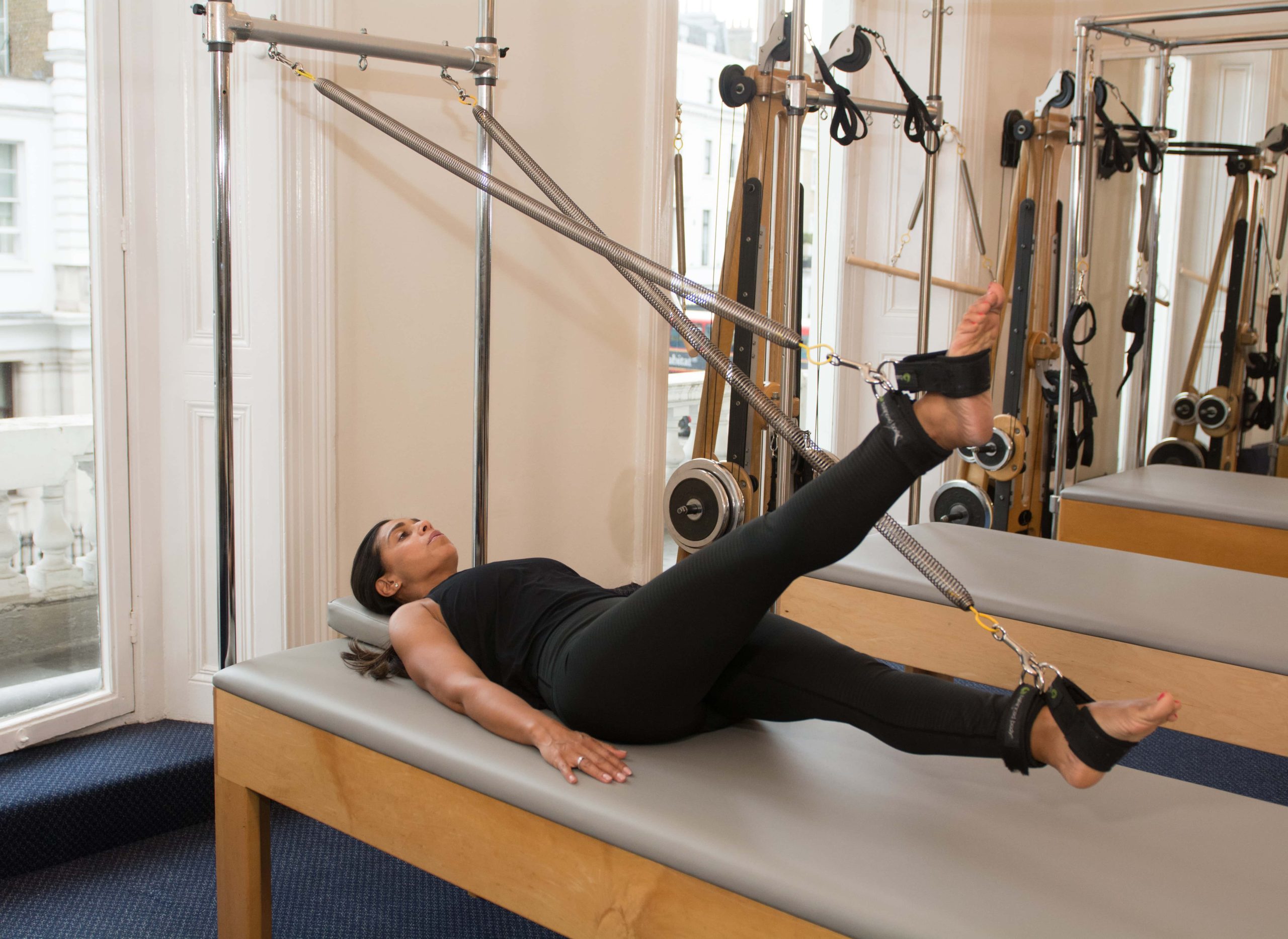
Yes — pilates can be an excellent form of rehabilitation after knee replacement surgery. With an experienced teacher who understands post-surgical recovery, pilates helps rebuild strength around the new joint, restore alignment, and return you to confident, comfortable movement. The key is starting carefully, progressing slowly, and working with someone who knows when to push and when to hold back.
Can you do pilates after knee replacement?
Pilates is well-suited to knee replacement rehabilitation because it is low-impact, highly controlled, and focused on alignment and muscle function rather than load or speed. After a knee replacement — whether total or partial — the surrounding muscles typically weaken, and movement patterns become guarded and compensatory. Pilates works to address both.
Done well, pilates after a total knee replacement helps retrain the muscles that support the joint, correct imbalances that may have developed before surgery, and work through a gradually increasing range of motion without strain.
How soon after knee replacement surgery can you start?
Most people begin hospital-based physiotherapy within days of surgery. Specialist pilates is typically appropriate from around six to twelve weeks post-operation, once the initial healing phase is complete and your surgical team or physiotherapist has cleared you for more structured exercise. Every recovery is different, so timing should always be guided by your surgeon or physio rather than a fixed schedule.
Is pilates safe after total knee replacement?
Yes, with appropriate modifications and an experienced teacher. The concern with any post-surgical exercise is loading the joint before it is ready, or moving through ranges that are contraindicated by your specific implant. A pilates instructor with experience in post-surgical rehabilitation will know how to work within those parameters — progressing carefully as strength and mobility improve, rather than following a generic programme.
At Trevor Blount Pilates, all sessions are one-to-one. Every client is assessed individually before we begin, and the programme is built entirely around where you are in your recovery.
Why pilates works for knee replacement recovery
Knee replacement surgery addresses the joint itself — but the months of pain and restricted movement that typically precede it leave a legacy in the surrounding tissue. Muscles weaken, walking patterns shift, and the whole body adjusts around the damaged knee. Recovery is not just about the new joint. It is about restoring function throughout.
This is where pilates is particularly effective.
Rebuilding strength in the right muscles
The quadriceps — the muscles at the front of the thigh — are central to knee stability and function. They tend to weaken significantly both before and after knee replacement surgery. Pilates targets these muscles with precision: controlled, low-resistance work that reactivates and rebuilds without excessive loading on the joint.
The hamstrings, glutes, and hip stabilisers all play an important role in supporting the knee. Pilates addresses each of these as part of a balanced approach to lower body rehabilitation.
Correcting the compensations surgery leaves behind
One of the things we observe consistently in clients who come to us after knee replacement is how much the rest of the body has adapted to protect the painful knee. The hip may hitch, the foot turn out, the pelvis shift. These patterns are natural — but left unaddressed, they can create new problems over time.
Pilates is exceptionally well-suited to identifying and correcting these compensations, because it requires you to slow down, pay close attention to your body, and work with precision rather than momentum.
The reformer in knee replacement rehabilitation
The pilates reformer is a particularly useful tool in post-surgical recovery. The spring resistance system allows for very light loads in the early stages, progressing gradually as strength returns. Many exercises can be done lying down or seated, which reduces loading on the joint while still engaging the necessary muscles effectively.
Reformer pilates for knee replacement is not about working hard — it is about working carefully, building a foundation that allows the new joint to function as it should.
Pilates exercises for knee replacement: what to do and what to avoid
What to focus on in the early stages
In the early phases, the priorities are gentle activation, circulation, and beginning to reconnect with the muscles around the joint. Foot and ankle work, gentle supine leg movements, and hip activation exercises form the foundation. Everything is adapted to the individual — there is no standard programme that applies to every client.
Breathing is also part of this. Deep, coordinated breathing reduces muscular tension, calms the nervous system, and supports the healing process. It is rarely discussed in the context of knee rehabilitation, but it matters.
Pilates exercises to avoid after knee replacement
Certain movements should be avoided following knee replacement surgery — either temporarily or indefinitely, depending on your implant and your surgeon’s guidance. As a general rule, these include:
- Deep knee flexion beyond the range specified by your surgical team
- Full squats and deep lunges
- High-impact movements of any kind
- Exercises that place rotational force through the knee joint
It is also worth noting that kneeling — even when technically safe — is often uncomfortable after knee replacement, sometimes for a long time. Scar tissue and changes in nerve distribution around the joint can make direct pressure on the prosthetic area feel extremely sensitive. This is not unusual, and it does not mean something is wrong. At Trevor Blount Pilates, any exercise that involves kneeling is either adapted to a different position or done with appropriate padding and support. If kneeling exercises have been putting you off trying pilates after surgery, that is not a barrier here.
A pilates instructor experienced in post-surgical rehabilitation will know which movements to avoid, which to modify, and when to begin reintroducing them. If you are working with someone without that background, the risk of doing something contraindicated increases significantly.
Pilates modifications for knee replacement
Almost every pilates exercise can be modified to be safe and appropriate after knee replacement. Foot bar positions on the reformer can be adjusted, range of motion limited, resistance reduced, and body position changed to unload the joint. The advantage of one-to-one pilates is that every modification is made in real time, based on what you are experiencing in the session.
What to expect at Trevor Blount Pilates
Trevor Blount has over 40 years of experience working with clients recovering from surgery, including hip and knee replacements. Post-surgical rehabilitation is one of the studio’s core areas of expertise.
Every new client begins with an individual assessment — a chance to understand your medical history, your current movement, and what your body needs. From there, the programme is built specifically for you. There is no rushing, no generic protocol, and no assumption that your recovery will follow a set timeline.
Many of our post-surgical clients tell us that what they value most is not feeling pushed — that sessions are genuinely adjusted to where they are on a given day, because recovery is not linear, and a teacher who understands that makes a real difference.
If you are recovering from knee replacement surgery and want to understand whether pilates might help, we would be glad to talk. Get in touch here.
You may also find our post on Pilates for Osteoporosis useful if bone density is part of your wider health picture.
