

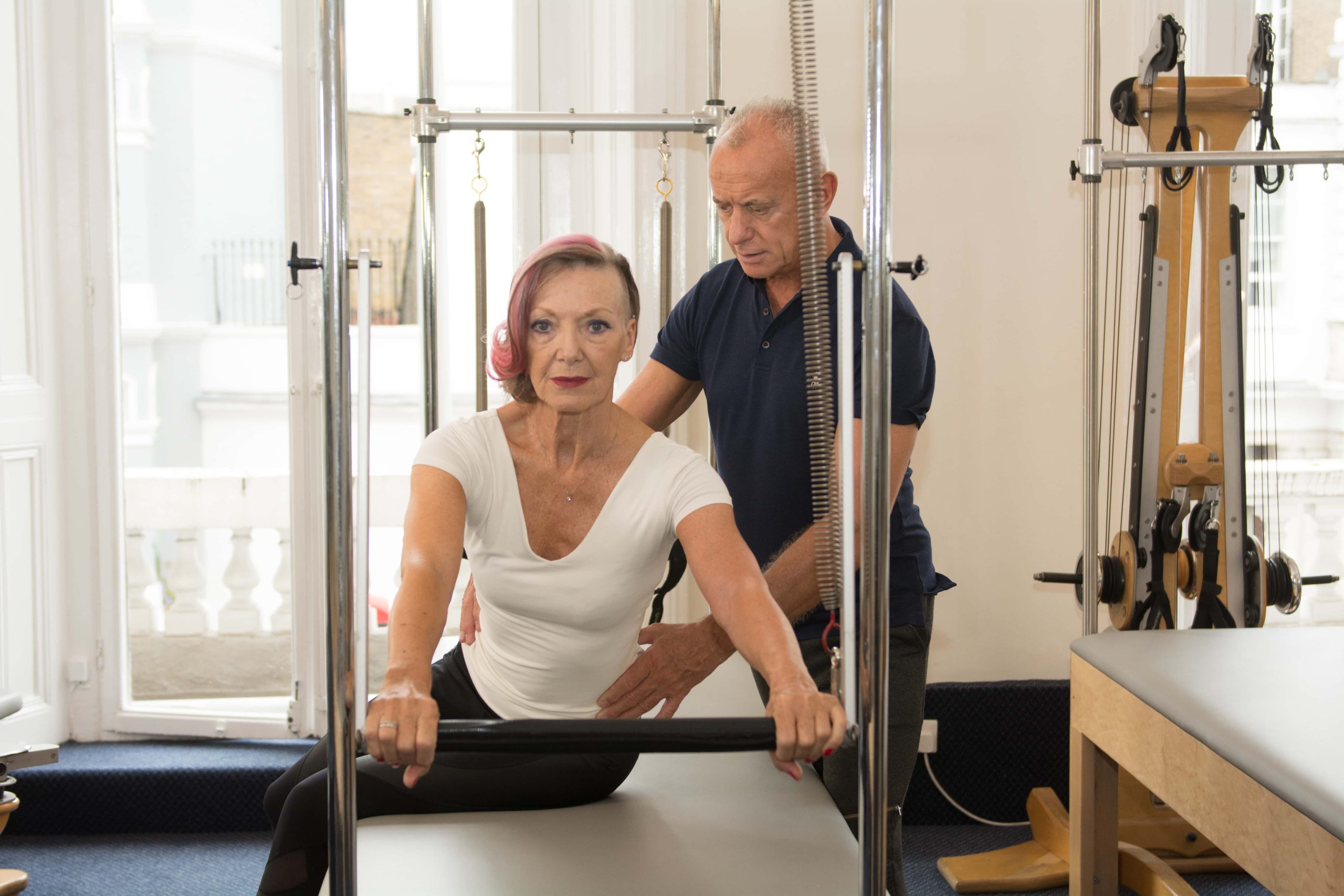
Osteoporosis changes the way you have to think about movement. Not because movement becomes impossible — but because the wrong kind of movement, done without sufficient care, carries real risk. That distinction matters enormously, and it tends to get lost when people are simply told to “stay active.”
Pilates, when taught correctly and adapted to the individual, is one of the most appropriate forms of exercise available to people with osteoporosis. It builds strength without impact, improves posture and balance, and works with the body’s structure rather than against it. But the word “correctly” is doing a lot of work in that sentence. Unsupervised Pilates, or classes that weren’t designed with bone health in mind, can be counterproductive — and in some cases harmful.
This is a question we encounter regularly at our South Kensington studio, and it deserves a careful answer.
Is Pilates Good for Osteoporosis?
Yes — Pilates can be highly beneficial for people with osteoporosis, provided it is taught by an experienced instructor who understands how to modify exercises for reduced bone density. The method supports bone health in several important ways: it loads the spine and long bones through controlled resistance, it strengthens the postural muscles that protect the vertebrae, and it trains balance and proprioception, which reduces the risk of falls.
The key word throughout is supervision. Pilates for osteoporosis is not the same as general fitness Pilates. It requires individual assessment, careful exercise selection, and ongoing adaptation as the client progresses.
Why Pilates Works Well for Bone Health
Is Pilates a Weight-Bearing Exercise for Osteoporosis?
This question comes up often, and the answer is nuanced. Traditional weight-bearing exercise — walking, for example — loads the skeleton through gravity and ground reaction force. Pilates on the apparatus works differently: it uses spring resistance to create load through the muscles and bones without the impact associated with high-intensity activity.
Some apparatus-based exercises, particularly standing work on the reformer or footwork sequences, do involve meaningful skeletal loading. Others, done lying down or seated, are lower-load but still valuable for muscular strength and control. A well-designed programme will include both, calibrated to what the individual’s skeleton can safely tolerate.
Mat Pilates is generally lower-load than apparatus work, which is one reason we work predominantly on the full classical apparatus at our studio. You can read more about how the equipment alters skeletal loading in our guide on Mat Pilates vs Apparatus Pilates. The springs provide graduated, controllable resistance that can be increased incrementally as strength improves.
Posture and Spinal Support
Osteoporosis often leads to a gradual forward rounding of the upper spine — a pattern known as kyphosis — as the vertebrae lose density and begin to compress. Pilates directly addresses the muscular weakness that allows this to develop. Work on the back extensors, the deep spinal stabilisers, and the muscles of the shoulder girdle all contribute to holding the spine in a more upright, supported position.
This is not cosmetic. Improved posture reduces the compressive load on already-vulnerable vertebrae and decreases the risk of fracture over time.
Balance and Fall Prevention
Falls are the primary injury risk for people with osteoporosis, and a significant proportion of Pilates work — particularly on the reformer and the Cadillac — develops the balance, coordination, and proprioception that fall prevention depends on. The controlled, attentive nature of the practice also trains the neuromuscular system: the connection between the brain and the body that governs how quickly and effectively you respond when your balance is challenged.
In our experience, clients with osteoporosis who work consistently over months notice tangible improvements in how steady and confident they feel on their feet. That matters day to day, well beyond the studio.
Can You Do Pilates If You Have Osteoporosis?
Yes, in most cases — but with modifications, and under proper guidance. Osteoporosis is not a contraindication to Pilates. It is a reason to approach Pilates more carefully and selectively than a general fitness client would.
Before beginning, an instructor needs to understand the degree of bone loss, the sites most affected, any history of fracture, and any other conditions that may affect movement. At Trevor Blount Pilates, every new client receives an individual assessment before their first session. For clients with osteoporosis, this assessment is especially important: it shapes every exercise decision that follows.
Which Pilates Exercises to Avoid with Osteoporosis
This is one of the most important practical questions, and the answer is not always obvious from a standard Pilates class.
Exercises that involve strong spinal flexion — rolling through the spine, deep forward bends, curl-up sequences — place compressive load on the front of the vertebral bodies, which is precisely where osteoporotic fractures most commonly occur. This danger is why the Royal Osteoporosis Society recommends modifying or avoiding classical movements like the Roll Down or Rolling Like a Ball in favour of flat-back variations. These movements are appropriate for many people but should be avoided or heavily modified for clients with significant spinal bone loss.
Rotation under load also carries risk, particularly at the thoracic spine, and needs careful management.
High-impact movements, though less common in classical Pilates than in some contemporary reformer classes, are not appropriate.
What remains — and it is a great deal — is a full programme of extension work, lateral movement, standing balance, footwork, and controlled resistance exercise that strengthens the body without loading the spine in vulnerable directions. A skilled instructor will build a programme that is both safe and genuinely challenging.
This is one reason we are cautious about large group reformer classes for clients with osteoporosis. The modifications required are significant enough that they are difficult to deliver safely in a group setting, particularly one moving at pace. We explore this dynamic further in our article on why fast-paced reformer classes can compromise joint and bone safety.
Is Reformer Pilates Good for Osteoporosis?
Reformer Pilates can be excellent for osteoporosis — but again, the teaching context matters enormously. The reformer provides spring-loaded resistance that can be carefully calibrated, and many reformer exercises are naturally well-suited to extension-focused, low-flexion work. Footwork on the reformer, for instance, loads the hip and leg bones through a controlled push, which supports bone density in the lower extremities.
The reformer becomes less appropriate when used in a fast-paced group class format where exercises are not selected or modified with bone health in mind. The same piece of equipment, in two different teaching contexts, can produce very different outcomes for a client with osteoporosis.
At our studio, reformer work sits within a broader programme that also draws on the Cadillac, the Wunda Chair, and other apparatus — chosen for each individual based on what their body needs at that point in their progress.
What to Expect at Trevor Blount Pilates
Trevor Blount has worked with clients with osteoporosis and osteopenia throughout his 40 years of teaching. Several of our instructors have specific experience in this area, and all are trained in the Trevor Blount Method — which begins, always, with individual assessment.
For clients with osteoporosis, sessions are one-to-one. There are no group classes at our studio. Every programme is built around the individual’s specific bone health, physical history, and goals — and it evolves as strength, balance, and confidence develop.
The studio is based in South Kensington and has been running in the same location since 1991. If you are living with osteoporosis or osteopenia and want to understand whether Pilates is right for you, we are glad to talk it through before you commit to anything.
You can find more about our approach on our sessions page or read about how we work with hypermobility and other conditions.
Trevor Blount Pilates is a classical Pilates studio in South Kensington, London. We offer one-to-one sessions for clients with a range of conditions, including osteoporosis, osteopenia, post-surgical rehabilitation, and chronic pain.
