

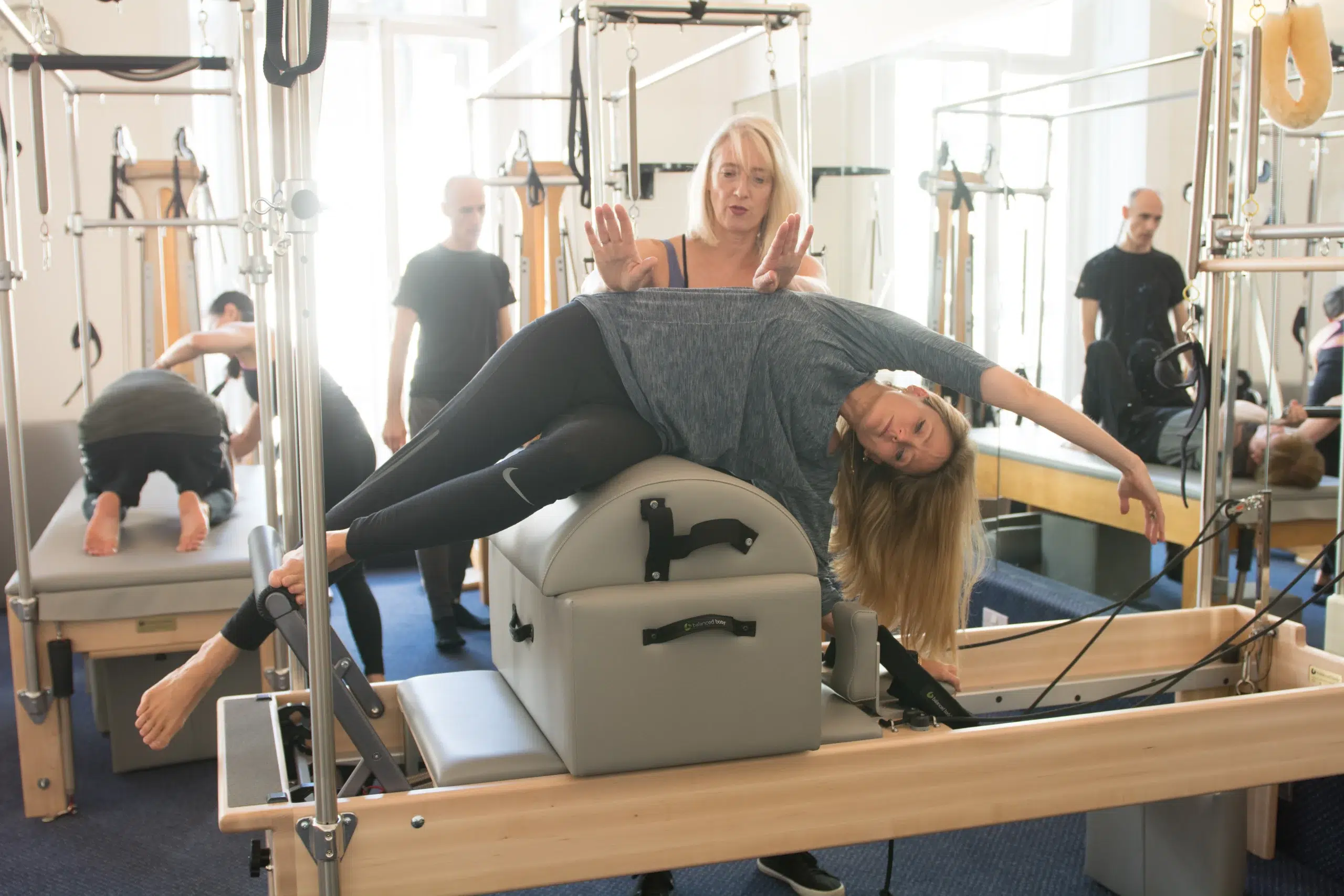
There is a version of this article that most Pilates studios have already written. It compares mat and reformer Pilates on the basis of cost, accessibility, and beginner suitability. It includes a table. It ends by saying both are excellent and the right choice depends on your goals. Then it links to the class schedule.
This is not that article.
What most of those comparisons miss — and what matters most for anyone approaching Pilates for structural health, rehabilitation, or long-term movement quality — is that the reformer is not the full picture. It is one piece of a much larger and more considered system. And it is that system, not any single piece of equipment, that makes apparatus-based Pilates genuinely different from mat work.
Understanding the distinction begins with understanding what mat Pilates actually is, and where its limits lie.
What Is Mat Pilates?
Mat Pilates is the original form of the practice. Joseph Pilates developed a classical sequence of 34 exercises — performed on the floor using the body’s own weight as resistance — that remains the foundation of the method. The work is demanding in the most direct way possible: there is nothing external to assist you, correct you, or provide feedback. Gravity is the only constant. The body must find its own stability, generate its own support, and control its own movement from the inside out.
This makes mat Pilates genuinely challenging. Clients who assume it will feel simple because there is no equipment are usually surprised. The 100, the roll-up, the double-leg stretch — exercises that look straightforward on paper reveal immediately whether a person’s deep stabilisers are actually working. You cannot borrow stability from a machine on the mat. Either the body can do it or it cannot.
For building foundational body awareness, for developing the kind of intrinsic muscular control that supports everything else, mat work has clear value. Many people practice it for years and derive real benefit. The discipline it requires is also, in a sense, the point — working against pure gravity with no assistance develops a quality of attention to the body that transfers well into daily movement.
The question is not whether mat Pilates works. It does. The question is what it cannot do — and for whom that limitation matters most.
What Is the Classical Pilates Apparatus?
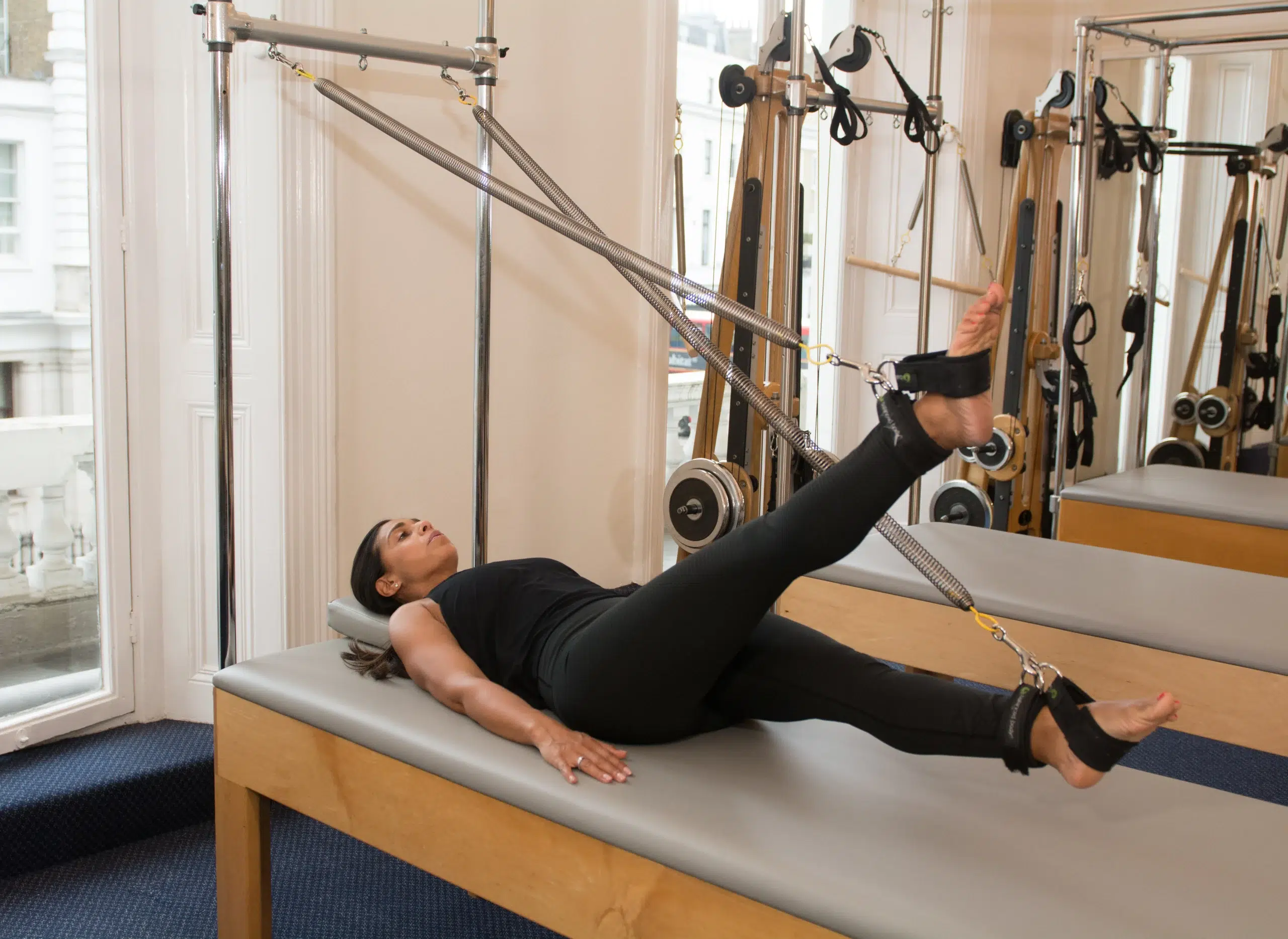
Joseph Pilates did not design the mat sequence as a standalone system. He designed it alongside a suite of equipment — collectively called the apparatus — that extended the method into movement territory the mat alone could not reach.
The apparatus is not a collection of alternatives to the mat. Each piece was conceived to do something specific, to address a particular demand on the body that no other piece in the system — including the mat — could address in the same way.
The reformer is the best known: a spring-loaded carriage that moves along a horizontal track, offering adjustable resistance in multiple directions. Its springs can assist movement — making exercises accessible for those who lack the strength or mobility to perform them independently — or resist it, increasing the demand on specific muscle groups. The reformer is extraordinarily versatile, but it is one piece of a larger picture.
The cadillac, also called the trapeze table, extends the work into vertical planes. Springs attach from above as well as below, allowing exercises that are impossible on the reformer or mat. For clients who cannot get up and down from the floor easily — post-surgical patients, older adults with balance concerns, those managing osteoporosis — the cadillac provides access to the full range of Pilates work without the physical demands of floor-based movement.
The wunda chair places the body in standing and seated positions that challenge single-leg stability, balance, and deep hip stabiliser engagement in ways the horizontal apparatus cannot replicate. The demands it places on proprioception — the body’s sense of its own position — are among the most direct in the entire system.
The ladder barrel and spine corrector address spinal mobility and extension: the curving surfaces support the spine in positions of flexion and extension that allow controlled movement through ranges the flat mat surface simply does not accommodate.
Together, these pieces do not represent a more expensive version of the same thing. They represent a genuinely different scope of what is possible — in terms of how the body can be positioned, how resistance can be applied, how movement can be supported or challenged, and how precisely an instructor can target a specific structural need.
Mat Pilates vs Apparatus Pilates: What the Equipment Actually Changes
The most important difference between mat and apparatus work is not the level of difficulty. It is the degree of individual control available to the instructor — and what that makes possible for the client.
On the mat, modification options are limited. An instructor can use props, adjust the exercise version, or ask the client to reduce range. But the fundamental parameters of the movement — the resistance, the angle of loading, the position of the body relative to gravity — are fixed. You are on the floor, working against your own bodyweight, and there is a ceiling on how much can be adjusted.
On the apparatus, every session can be calibrated to the individual in real time. Spring tension can be increased or reduced mid-exercise. The carriage position can be changed. Straps can be lengthened or shortened. Body angle can be shifted. For an instructor working with a client whose left hip loads differently to the right, or whose thoracic spine will not extend past a certain point, or who is six weeks out of surgery and needs load introduced gradually over many sessions — this granularity is not a luxury. It is the mechanism by which rehabilitation actually happens.
The table below illustrates the core differences, though the most important ones are harder to put in a table than the obvious ones:
| Mat Pilates | Full Apparatus Pilates | |
|---|---|---|
| Resistance source | Bodyweight and gravity | Adjustable spring resistance |
| Individual adaptation | Limited | Extensive — adjustable mid-session |
| Rehabilitation suitability | Moderate | High — especially post-surgical |
| Floor work required | Yes, throughout | No — many exercises non-floor-based |
| Instructor observation | Partially obscured by floor position | Full view of alignment and movement |
| Proprioceptive training | Static surface | Dynamic — moving surfaces provide feedback |
| Exercise range | 34 classical exercises + variations | Hundreds across the full apparatus suite |
The row on instructor observation is worth pausing on. When a client is lying on a mat, large portions of their body — the back surface, the contact between the spine and the floor, the relationship between the pelvis and the ribcage — are effectively hidden from the instructor’s view. On the reformer or cadillac, the instructor can observe the full body from any angle. This changes what the instructor can see, and therefore what they can correct. In rehabilitation work, where the details of alignment and compensation are often exactly what needs addressing, this difference is significant.
Where Mat Pilates Remains Valuable
None of the above is an argument that mat Pilates is without merit, and it would be dishonest to present it that way.
Clients who have developed a serious mat practice often bring a quality of body awareness to apparatus work that makes their progress faster than those who have not. The discipline of working without external support — of having to generate stability entirely from within — builds something that translates well. Joseph Pilates designed mat and apparatus work as complementary parts of a single system, not as alternatives. In an ideal world, a serious Pilates practice includes both.
Mat Pilates also remains the more accessible option for many people: it can be practised at home, requires no equipment, and can be maintained independently between studio sessions. For clients who travel regularly, or who want to sustain their work between appointments, a well-developed mat practice is genuinely useful.
What mat work is not well suited to is the precise, individualised structural work that rehabilitation requires — or the nuanced adaptations that a body with significant asymmetry, injury history, or post-surgical needs demands. In those contexts, the apparatus does things the mat simply cannot.
Who Benefits Most From Apparatus-Based Pilates?
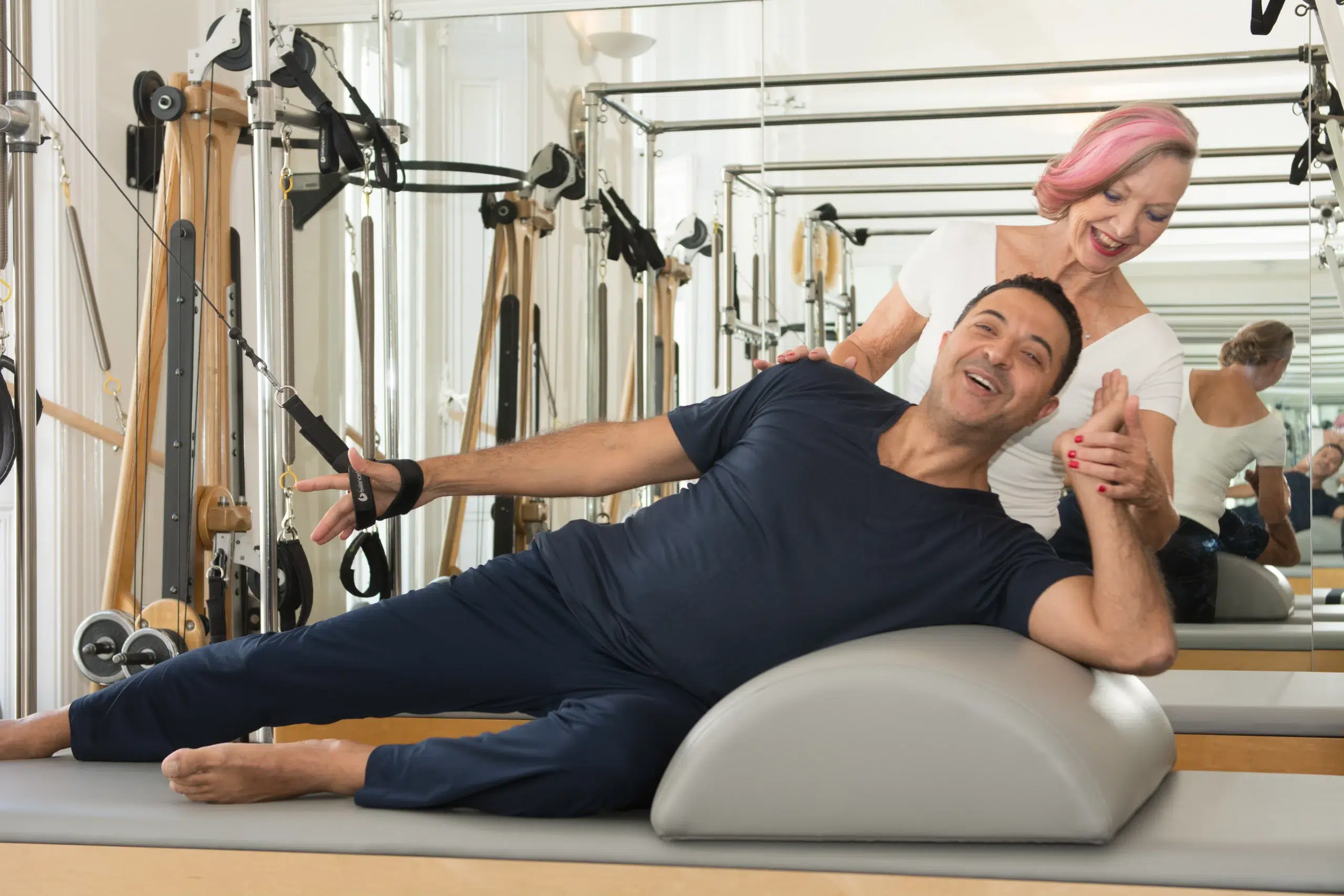
The full apparatus is most valuable — and often most necessary — for clients whose movement has been shaped by injury, surgery, or structural imbalance. This includes those in recovery from hip or knee replacement, spinal surgery, or significant joint procedures; those managing hypermobility or joint instability, where the apparatus can provide support that prevents unsafe loading; older adults for whom repeated floor work is physically difficult or carries genuine risk; and anyone whose goal is not general fitness conditioning, but specific structural change — better alignment, resolved chronic pain, a walking pattern that no longer compensates for an old injury.
The common thread is that all of these people need something tailored to their specific body, not a general programme applied uniformly. The apparatus is the tool that makes that level of tailoring possible.
The Role of the Apparatus in Clinical Pilates
It is worth being precise here, because the reformer has become so associated with fitness-format Pilates studios that some people assume apparatus work and group reformer classes are the same thing. They are not.
A group reformer class that moves ten participants through a standardised sequence at pace is using the apparatus as a fitness tool. The equipment is there; the clinical application is not. What makes clinical, rehabilitation-informed Pilates different is not which pieces of apparatus are present, but how they are used — beginning with individual assessment, proceeding through session design specific to that person’s body, and adapting continuously as the session unfolds.
The apparatus enables clinical Pilates. It does not guarantee it. That distinction is determined by the instructor, the assessment process, and the approach to the individual client — not by the equipment alone.
The Trevor Blount Approach
The full classical apparatus has been central to the work at the studio since Trevor began teaching. Not as a gesture toward tradition, but because each piece does something specific that the others cannot, and the clients who benefit most from the studio’s work are precisely those for whom that precision matters.
No two clients use the apparatus in the same way. The programme that emerges from an individual assessment reflects that person’s structural history, current movement patterns, and specific goals. The apparatus provides the range of tools that makes a genuinely individual programme possible. Without it, the level of adaptation available to the instructor is significantly constrained.
More detail about the principles behind our method is on the studio’s method page. If you are trying to work out whether apparatus-based Pilates is the right approach for your particular situation, the most direct route is a conversation with the studio rather than more research online.
Frequently Asked Questions
Can I come to apparatus Pilates if I have only ever done mat classes?
Yes — and a background in mat Pilates is often a genuine advantage. The body awareness developed through mat work tends to transfer well to apparatus sessions. There is no requirement to have done anything specific before starting; the initial assessment maps where you are, and the programme begins from there.
Is the classical Pilates apparatus the same as reformer Pilates?
No. The reformer is one piece of the classical apparatus system — arguably the most versatile, but still one component. The full classical system includes several other pieces, each designed to address movement demands that the reformer alone cannot replicate. “Reformer Pilates” as a term has come to describe a specific fitness studio format; the classical apparatus describes the complete system Joseph Pilates originally designed.
Do I need to learn mat Pilates before using the apparatus?
No. In a clinical, assessment-led setting, the instructor designs the programme around the individual’s body, not around a prerequisite sequence. Many clients come to apparatus work with no prior Pilates experience, and begin exactly where their body is. The assessment determines the starting point; there is no fixed entry requirement.
Trevor Blount Pilates is based in South Kensington, London. We offer individual assessments and one-to-one sessions using the full classical Pilates apparatus. To learn more about our method or to speak with the studio, contact us here.
