

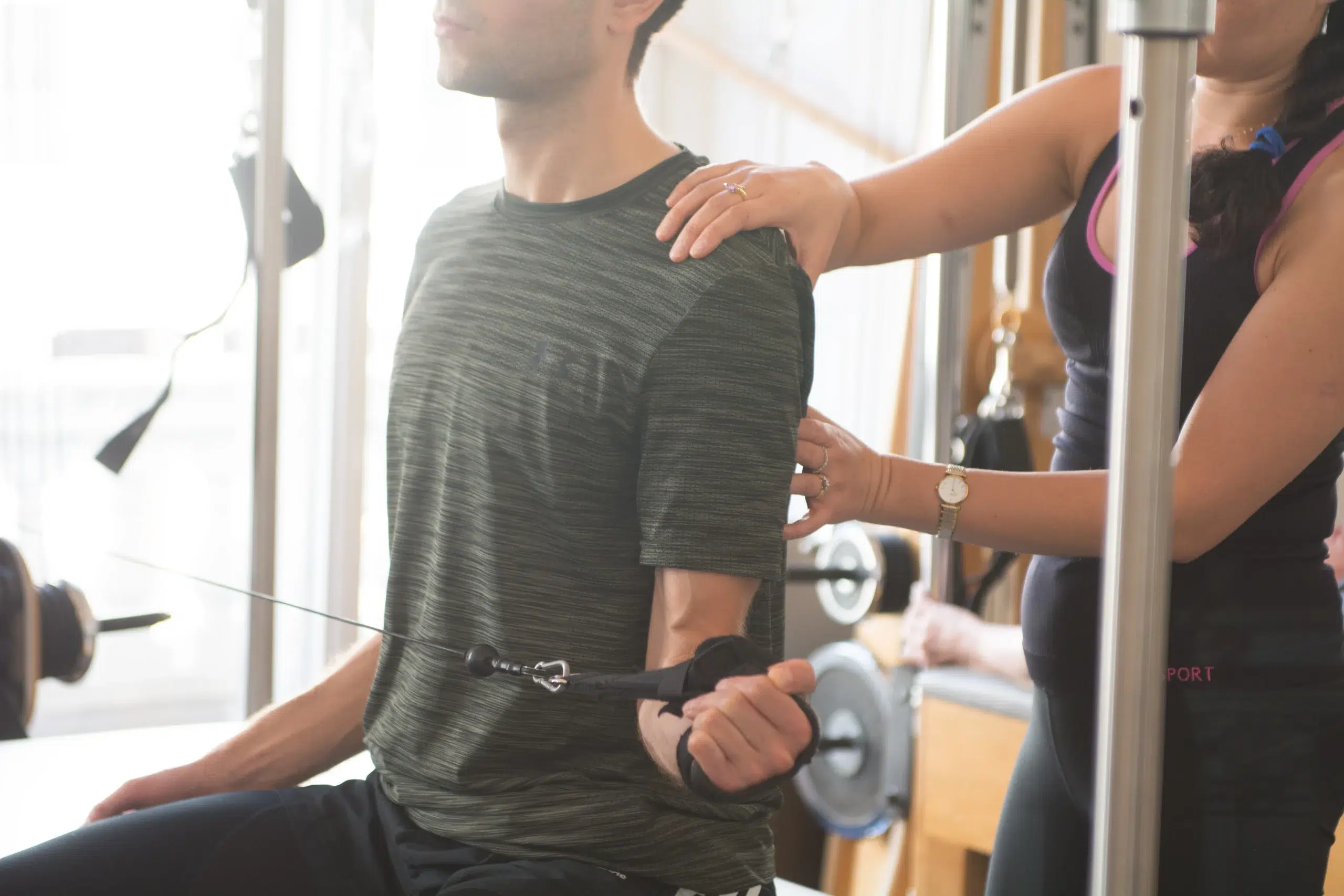
Is Pilates actually good for men? If you’ve walked past a studio in Wimbledon, Chelsea, or Knightsbridge and seen a class full of women on reformers, it’s a fair question.
The stigma is real, but the data isn’t. Joseph Pilates was a boxer, gymnast, and self-defence instructor who created the method for men. Today, Premier League footballers, rugby players, and UFC fighters use it for performance and injury prevention. Pilates isn’t light exercise. When taught properly, it’s one of the most effective systems for building strength, mobility, and resilience. Here’s why more men are starting.
Is Pilates Good for Men?
Yes — especially if you care about strength that lasts, mobility you can use, and staying injury-free.
Strength
Pilates builds deep stabilising muscle — transverse abdominis, multifidus, pelvic floor, obliques — that heavy lifting often misses. That’s why men who can bench 120kg still shake during a 30-second plank on the reformer. It’s a different kind of strength, and it’s the kind that protects your back.
Mobility
Most men lose hip and thoracic mobility by 35. Desk work, driving, and gym training without stretching shortens everything. Pilates restores range through full movement, not passive stretching. You get flexible without losing power.
Injury prevention
Hamstring tears, lower back pain, and knee issues usually come from imbalance — strong quads with weak glutes, tight hips with a weak core. Pilates identifies and corrects those patterns before they break you. That’s why physios refer men here after surgery.
Frame it right: This is performance training, not light exercise. It’s used by elite athletes because it fixes weaknesses that cost them games. For desk workers, it reverses 8 hours of sitting. For gym-goers, it makes every lift safer.
Key Benefits of Pilates for Men
-
Core strength — not just abs: Forget crunches. Pilates trains deep stabilisers that wrap your spine like a corset. That’s what stops your lower back from giving out during deadlifts or golf swings.
-
Improved posture: If you work at a desk, your shoulders are forward, hip flexors tight, and glutes asleep. Pilates rebalances that. Shoulders sit back, neck pain drops, and you look taller because you actually are — decompressed and aligned.
-
Injury prevention: Most male injuries are overuse: back, hips, knees, shoulders. They happen because one muscle group overworks to compensate for another. Pilates teaches uniform development so nothing gets overloaded.
-
Flexibility without losing strength: Yoga can make you bendy but weaker. Pilates makes you mobile and strong at the same time. You gain range through control, so you keep the strength at end-range.
-
Better athletic performance: Power comes from the centre. If your core leaks force, your arms and legs can’t deliver it. Rugby players, cyclists, and runners use Pilates to transfer strength from core to limbs more efficiently.
Pilates vs Gym Training for Men
This isn’t either/or. They do different jobs.
Gym training = load-based strength
Barbells and dumbbells are best for maximum force production and hypertrophy. If your goal is to bench 150kg or add 10kg of muscle, the gym wins. It isolates muscles and loads them heavy.
Pilates = control, stability, longevity
Pilates integrates your body. It teaches muscles to work together, fixes imbalances, and builds strength you can use without pain. It’s best for movement quality, joint health, and performance under fatigue.
Positioning: Best results come from combining both. Pilates fixes what the gym misses — core stability, left-right balance, spinal articulation. The gym builds what Pilates can’t — maximal load. Many men in London do 2x gym, 1x reformer Pilates weekly.
Reformer Pilates for Men
This is where most men start and see the fastest strength gains.
Resistance-based training
Springs provide 5kg to 50kg+ of resistance. Unlike weights, the load changes through the movement. It’s hardest where you’re weakest, which forces real adaptation. You can’t cheat it.
Adjustable intensity
One exercise has 10 variations. Too easy? Add springs, remove base of support, or slow it down. A good teacher scales it so you’re always working, never flailing.
Ideal for beginners and athletes
For beginners, the carriage supports you so you can build strength without joint stress. For athletes, it exposes weaknesses instantly — if your left glute isn’t firing, the carriage won’t stay straight.
Common Misconceptions About Men Doing Pilates
-
“It’s too easy”: Try holding a teaser for 30 seconds with straight legs. Easy is relative to how well you do it. Most men who say this haven’t done it correctly.
-
“It’s just stretching”: There’s stretching in Pilates, but it’s active stretching under load. You’re strengthening at end-range, not passively pulling.
-
“It’s not for building muscle”: It won’t make you a bodybuilder. It will build lean, functional muscle — especially if you start deconditioned or have never trained stabilisers.
What to Expect in Your First Pilates Class
Walk in expecting it to be easier than the gym and you’ll be humbled. Walk in expecting judgment and you’ll be surprised.
Beginner-friendly
Good studios start everyone with an assessment or beginner class. You learn breathing, core engagement, and 5-6 foundational moves. No one expects you to know anything.
Focus on technique
The teacher will correct you constantly. Foot position, pelvis angle, breath timing. It feels slow because precision matters more than reps.
Slower but more intense than expected
You won’t be out of breath like HIIT. You’ll be shaking from muscular fatigue. Small muscles you’ve never felt will burn.
For pilates for male beginners, book 1:1 or small semi-private first. Learn the system before joining group classes. You’ll progress faster and avoid bad habits.
Why Men Benefit from Expert Coaching
-
Precision matters more than reps: 10 perfect reps with correct core engagement build strength. 50 sloppy reps build compensation and pain.
-
Avoid injury: Men often push through pain or use momentum. A good teacher stops you before you strain your neck or lower back.
-
Faster results: Expert coaching means every rep counts. You’re not wasting time on exercises your body isn’t ready for.
Technique-Focused Training for Men
At Trevor Blount Pilates in South Kensington, training is 1:1 or 2:1 only, 75 minutes long, and built on the classical system. The focus is strength, rehab, and long-term results. It’s ideal for men returning to fitness, professionals with back pain, and athletes who want strength without wear and tear.
Conclusion
Reframe Pilates as a serious training method. It builds core strength, fixes posture, prevents injury, and develops the kind of functional muscle that keeps you active for decades.
If you’re unsure, try a structured class. For men new to the method, start with a private reformer session in London so you learn it right. To understand how the method builds strength, read Can Pilates Build Muscle. For context on how studios differ by equipment and class type, see How Pilates Studios in London Differ.
Frequently Asked Questions
Is Pilates good for men?
Yes. Pilates builds core strength, improves posture, prevents injury, and increases mobility. It was created by a man and used by male athletes for performance. It’s especially effective for men 30–55 dealing with back pain or stiffness.
Can men build muscle with Pilates?
Yes, lean functional muscle. Reformer Pilates uses spring resistance and progressive overload to build strength. It won’t create bodybuilder bulk, but it develops strong glutes, core, back, and shoulders.
Is reformer Pilates better for men?
For strength and muscle building, yes. The reformer allows adjustable resistance and progressive overload. Most men start on reformer because the support lets them build strength safely.
How often should men do Pilates?
2-3 times per week for strength and postural change in 6-8 weeks. Once weekly maintains and complements gym training.
