

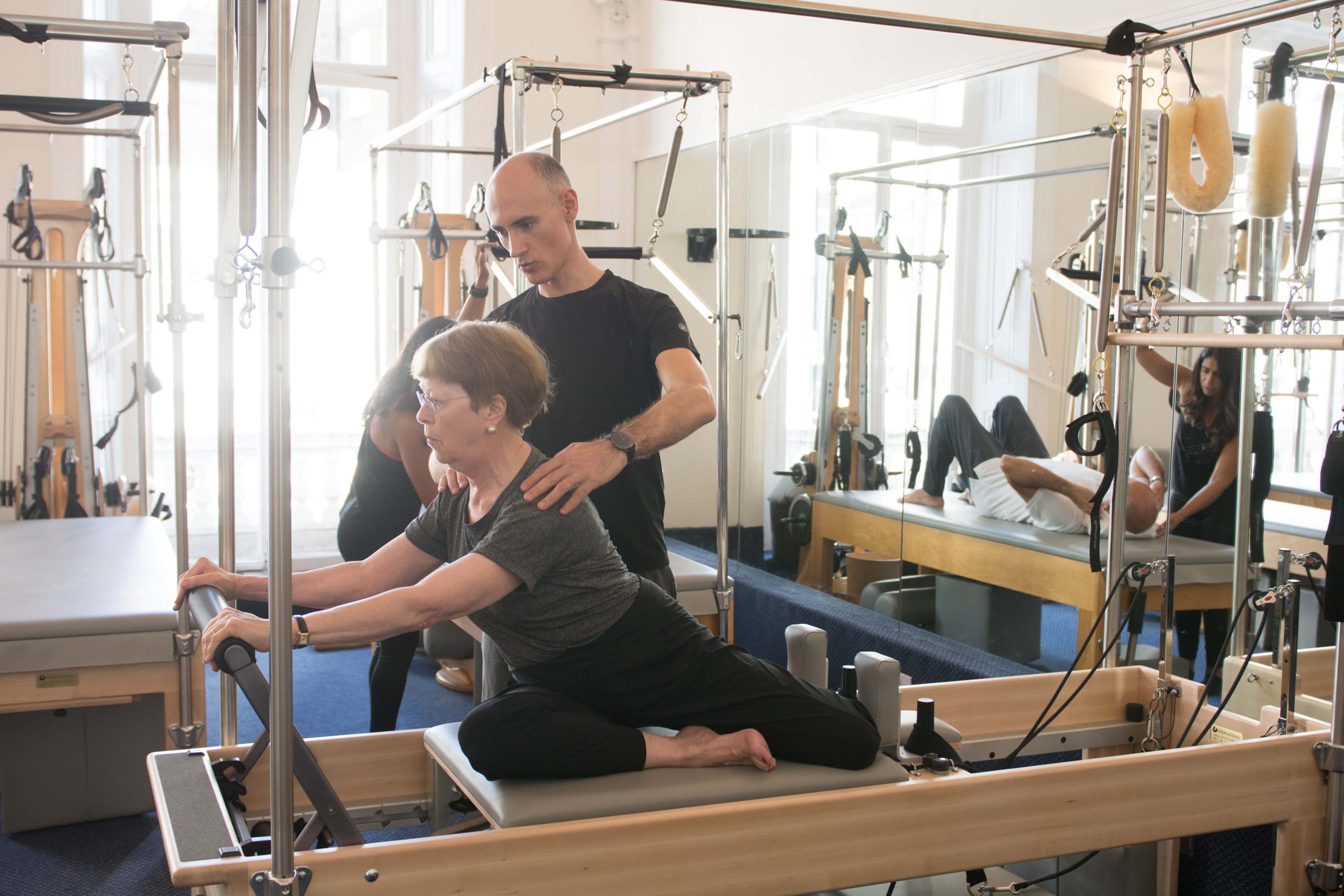
A client in her seventies once told me she’d never managed to stick with any form of exercise for more than a few weeks in her life. She’s been coming to the studio for six years now. Her son comes too.
I think about that often, because it says something important about what actually works for people later in life. It isn’t intensity. It’s precision, consistency, and a method that meets the body where it is rather than where a class assumes it should be.
Why balance and strength matter more with age
Muscle strength declines gradually with age if it isn’t actively maintained, and that decline affects balance and mobility long before it becomes obvious day to day. Balance itself is something that can be trained — the body relearns how to stabilise through movement, not through avoiding it.
This is where Pilates has a genuine advantage over many other forms of exercise for older clients. It works on strength, control, and balance together, using apparatus that supports the body while it learns, rather than leaving someone unsupported and at risk of a fall during the exercise itself.
What makes a one-to-one approach right for this stage of life
Group classes are built around an average — an average fitness level, an average pace, an average set of limitations. Nobody in later life is actually average. One person’s knees might be the limiting factor; another’s might be a hip replacement, or reduced confidence after a fall, or simply years of a desk job catching up with their posture.
We start every new client with an individual assessment, and for older clients this matters even more than usual. We’re not working from a template. We’re working from what this particular body can do safely today, and building from there — the same principle behind how we work with clients recovering from hip or knee replacement, managing osteoporosis, or living with osteoarthritis — all common considerations at this stage of life.
What a session actually involves
Movement is slow, controlled, and always within a safe range. There’s no rushing to keep pace with music or a group — because there’s no music at all. Just the client, the apparatus, and the guidance of someone paying close attention to how their body is responding.
Sessions build strength in the muscles that support posture and balance — particularly the deep core and the muscles around the hips and spine — while also working on the kind of controlled, functional movement that carries over into daily life: getting up from a chair, carrying shopping, walking without hesitation.
Is Pilates safe if I have joint pain or a previous injury?
Yes, when it’s tailored to that specifically. This is exactly the kind of situation individual assessment exists for — identifying what needs to be worked around, modified, or built up to gradually, rather than following a generic programme that doesn’t know your history.
Do I need to already be fit to start?
No. Some of the clients who’ve stayed with us longest started with very little prior exercise experience at all. What matters is starting at the right level for you, not arriving already capable.
How is this different from a general seniors’ fitness class?
A general class is designed for a room full of people at once, at one pace. What we do is designed around one person, adjusted every session to how that person’s body is responding that day. That’s a different kind of exercise altogether.
Ready to begin?
If you’d like a considered, individually assessed approach to building strength and confidence, get in touch to arrange a consultation.
