Please rotate your device.
S C R O L L

Pilates for Parkinson’s Disease: What to Expect from One-to-One Sessions

Parkinson’s disease affects movement in ways that are highly individual — the tremor that dominates one person’s experience may be barely present in another’s, while rigidity, slowness and balance difficulties can shift from week to week. This is precisely why generalised exercise classes often fall short for people managing Parkinson’s, and why the one-to-one format has always felt like the only honest way to work.

In over 40 years of practice, I’ve worked with clients at every stage of Parkinson’s. What I’ve consistently found is that the qualities built into classical Pilates — unhurried movement, breath awareness, deliberate precision — are exactly what Parkinson’s asks for. The disease tends to speed the body up in ways it doesn’t want to go. Pilates, by design, slows everything down.

Is Pilates Good for Parkinson’s Disease?

Yes. Pilates is well-suited to Parkinson’s disease because it addresses several of the condition’s core movement challenges: balance and postural instability, rigidity, reduced range of motion and the loss of confident, fluid movement. Research published in Medicina concluded that Pilates can be safely prescribed for people with mild-to-moderate Parkinson’s, with evidence of improvements in fitness, balance and physical function — and notably, that its benefits for lower-limb function appear superior to those of conventional exercise programmes.

What clinical studies reflect is something we see directly in the studio: when movement is practised slowly, with attention to the body rather than to a beat or a target, people with Parkinson’s find a quality of engagement that hurried exercise doesn’t offer.

How Does Parkinson’s Affect Movement — and Why Does That Matter for Exercise?

Parkinson’s disease is a neurodegenerative condition that gradually affects the brain’s ability to produce dopamine, the chemical responsible for coordinating smooth, controlled movement. The resulting symptoms — tremor, muscular rigidity, bradykinesia (slowness of movement), postural instability and reduced balance — create a pattern where movement becomes effortful and confidence erodes.

For exercise to be genuinely useful, it needs to meet the person where they are. High-impact or fast-paced classes demand a responsiveness the Parkinson’s nervous system often can’t reliably produce. They also risk falls, frustration and the reinforcement of compensatory patterns that make underlying difficulties worse over time.

This is why the assessment comes first, always. Before any movement, I want to understand how your body is currently organising itself: where rigidity is holding, how your balance responds when weight shifts, which postural patterns have developed, and what your body is ready to do safely. From there, sessions are built around what your specific nervous system and musculature need — not a generic programme.

What Can Pilates Help With in Parkinson’s?

Balance and fall reduction. Core engagement and postural control sit at the heart of classical Pilates work. Strengthening the deep stabilisers of the trunk, pelvis and lower limbs builds the physical foundation for steadier standing, walking and turning — movements that often become unpredictable with Parkinson’s progression.

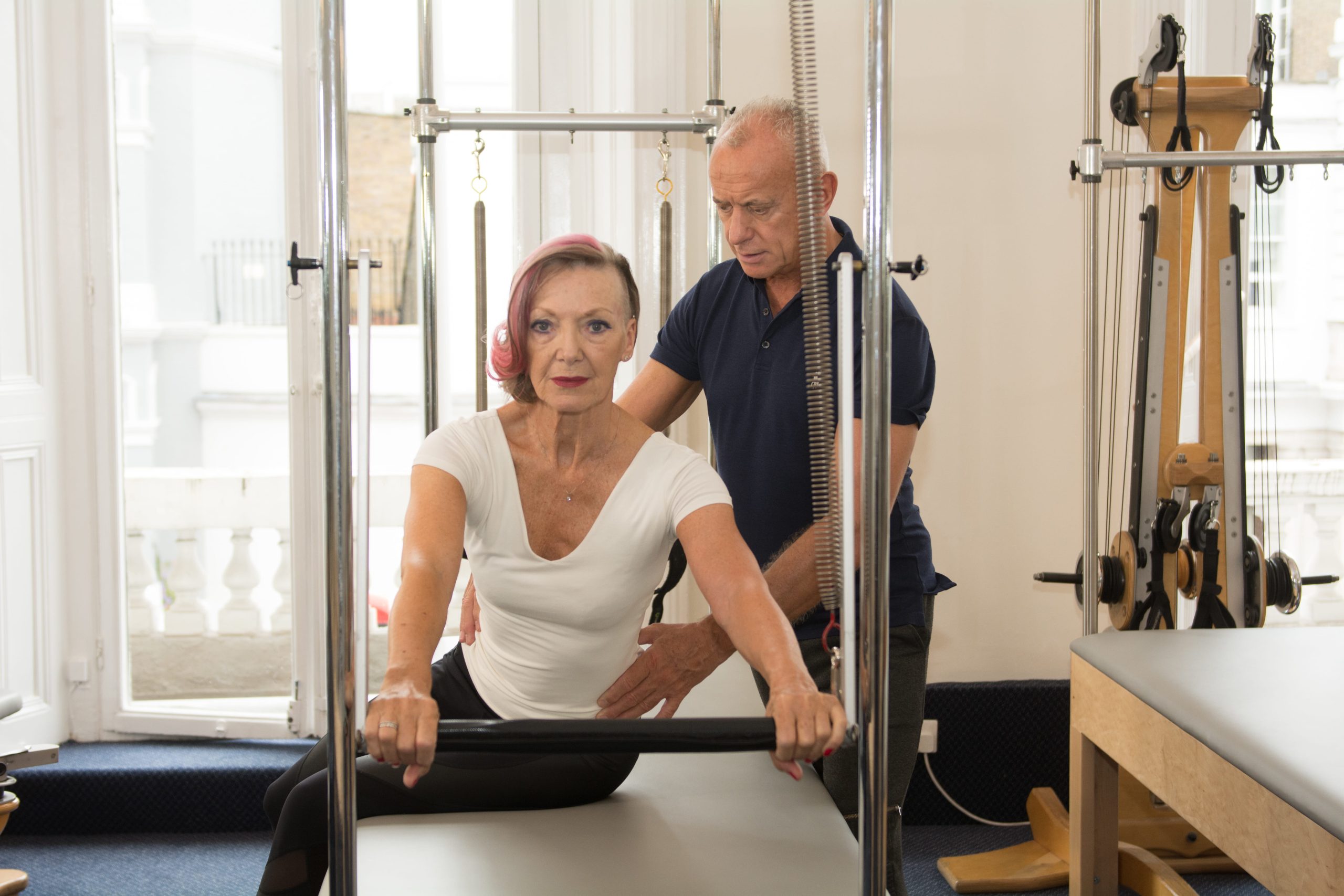
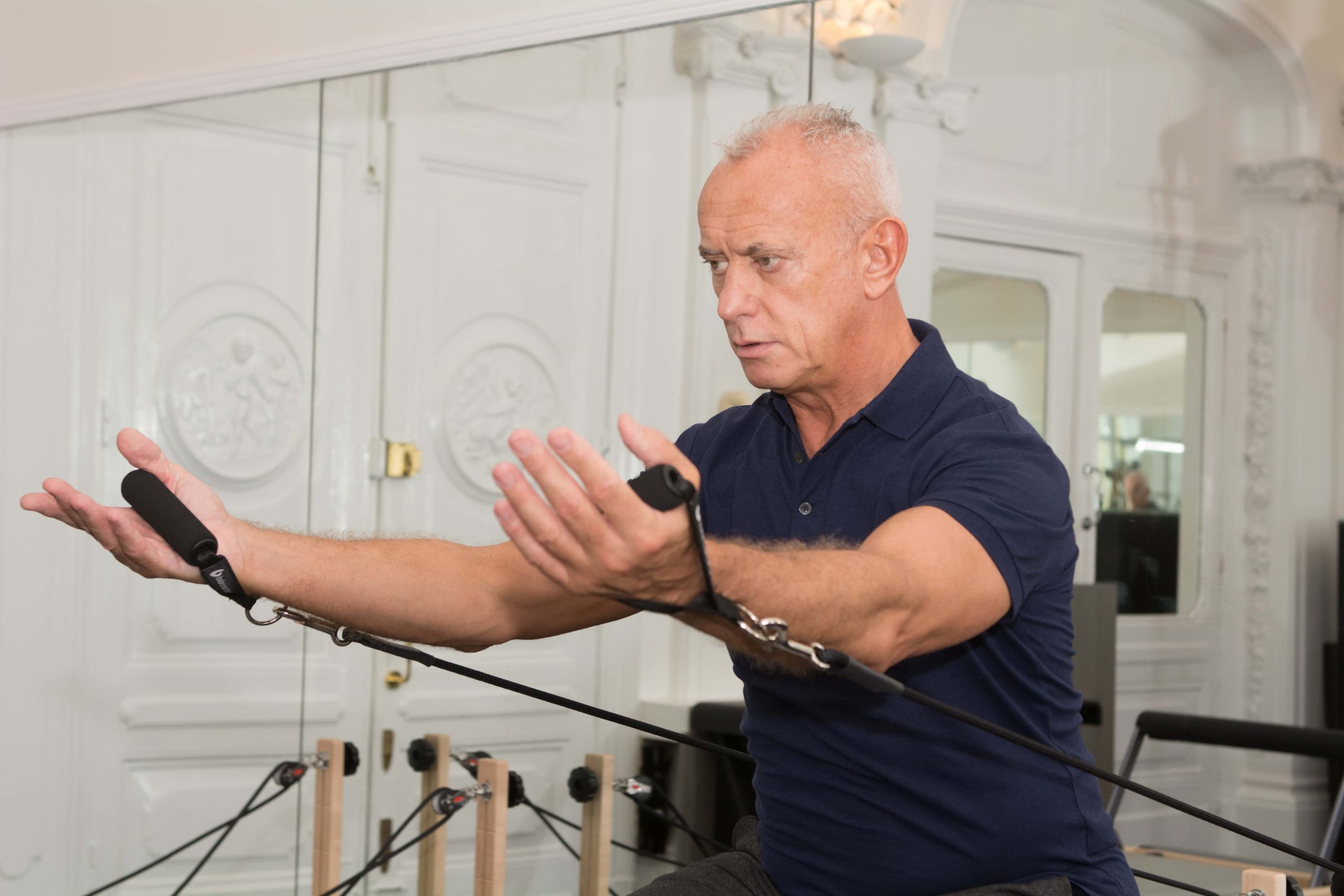
Reducing the effects of rigidity. Controlled mobilisation of the spine, hips and shoulders gradually addresses the muscular stiffness that contributes to the characteristic “frozen” quality of Parkinson’s movement. Work on the apparatus supports this particularly well: the spring-based resistance of the Cadillac and Reformer provides gentle, guided movement through ranges the body resists on its own.

Breathing and relaxation. One of the things I return to most often with Parkinson’s clients is the connection between breath and tension. When breathing becomes shallow and restricted — which Parkinson’s tends to encourage — postural collapse and muscular rigidity compound each other. Reestablishing a full, directed breath changes everything that follows. There’s a reason relaxation sits at the centre of how we work here: athletes at the starting blocks don’t think about the race, they find relaxation. The same principle applies in Parkinson’s rehabilitation.

Slower, more intentional gait. Working with deliberate, sequenced movement patterns can help retrain the nervous system’s approach to initiating and controlling movement. This carries into daily function in ways that matter practically — getting up from a chair, turning without stumbling, descending stairs.

Is It Too Late to Start Pilates with Parkinson’s?

It is not too late. Clients come to us at various stages of Parkinson’s, including those who have been managing the condition for many years. The starting point simply needs to be appropriate to where you are now — and that requires honest individual assessment, not a class template.

It is also worth noting that starting Pilates earlier in the course of the disease, when movement capacity is greater, makes the work easier and builds resilience before difficulties compound. But if you’re coming to it later, there is still meaningful work to be done.

What Is a Typical Session Like for Someone with Parkinson’s?

Sessions take place one-to-one or two-to-one at our South Kensington studio. The pace is always unhurried. There is no music. The intention is that your attention stays with your body throughout — noticing what you feel, how your weight distributes, where things are held. Early sessions will involve significant time on the apparatus in supported positions, building awareness before building load. We work from where you are, not from where a programme says you should be.

If you are already working with a neurological physiotherapist or consultant, we are happy to work alongside that care. We don’t position ourselves as a replacement for medical management — rather, as a complement to it that offers consistent, skilled one-to-one or two-to-one attention over time.

For an overview of how our approach differs from mainstream Pilates, see Our Method.

If you or someone you care for is managing Parkinson’s and considering whether Pilates might help, get in touch. The first conversation is always straightforward.
Pilates After Knee Replacement: What to Expect

Yes — pilates can be an excellent form of rehabilitation after knee replacement surgery. With an experienced teacher who understands post-surgical recovery, pilates helps rebuild strength around the new joint, restore alignment, and return you to confident, comfortable movement. The key is starting carefully, progressing slowly, and working with someone who knows when to push and when to hold back.

Can you do pilates after knee replacement?

Pilates is well-suited to knee replacement rehabilitation because it is low-impact, highly controlled, and focused on alignment and muscle function rather than load or speed. After a knee replacement — whether total or partial — the surrounding muscles typically weaken, and movement patterns become guarded and compensatory. Pilates works to address both.

Done well, pilates after a total knee replacement helps retrain the muscles that support the joint, correct imbalances that may have developed before surgery, and work through a gradually increasing range of motion without strain.

How soon after knee replacement surgery can you start?

Most people begin hospital-based physiotherapy within days of surgery. Specialist pilates is typically appropriate from around six to twelve weeks post-operation, once the initial healing phase is complete and your surgical team or physiotherapist has cleared you for more structured exercise. Every recovery is different, so timing should always be guided by your surgeon or physio rather than a fixed schedule.

Is pilates safe after total knee replacement?

Yes, with appropriate modifications and an experienced teacher. The concern with any post-surgical exercise is loading the joint before it is ready, or moving through ranges that are contraindicated by your specific implant. A pilates instructor with experience in post-surgical rehabilitation will know how to work within those parameters — progressing carefully as strength and mobility improve, rather than following a generic programme.

At Trevor Blount Pilates, all sessions are one-to-one. Every client is assessed individually before we begin, and the programme is built entirely around where you are in your recovery.

Why pilates works for knee replacement recovery

Knee replacement surgery addresses the joint itself — but the months of pain and restricted movement that typically precede it leave a legacy in the surrounding tissue. Muscles weaken, walking patterns shift, and the whole body adjusts around the damaged knee. Recovery is not just about the new joint. It is about restoring function throughout.

This is where pilates is particularly effective.

Rebuilding strength in the right muscles

The quadriceps — the muscles at the front of the thigh — are central to knee stability and function. They tend to weaken significantly both before and after knee replacement surgery. Pilates targets these muscles with precision: controlled, low-resistance work that reactivates and rebuilds without excessive loading on the joint.

The hamstrings, glutes, and hip stabilisers all play an important role in supporting the knee. Pilates addresses each of these as part of a balanced approach to lower body rehabilitation.

Correcting the compensations surgery leaves behind

One of the things we observe consistently in clients who come to us after knee replacement is how much the rest of the body has adapted to protect the painful knee. The hip may hitch, the foot turn out, the pelvis shift. These patterns are natural — but left unaddressed, they can create new problems over time.

Pilates is exceptionally well-suited to identifying and correcting these compensations, because it requires you to slow down, pay close attention to your body, and work with precision rather than momentum.

The reformer in knee replacement rehabilitation

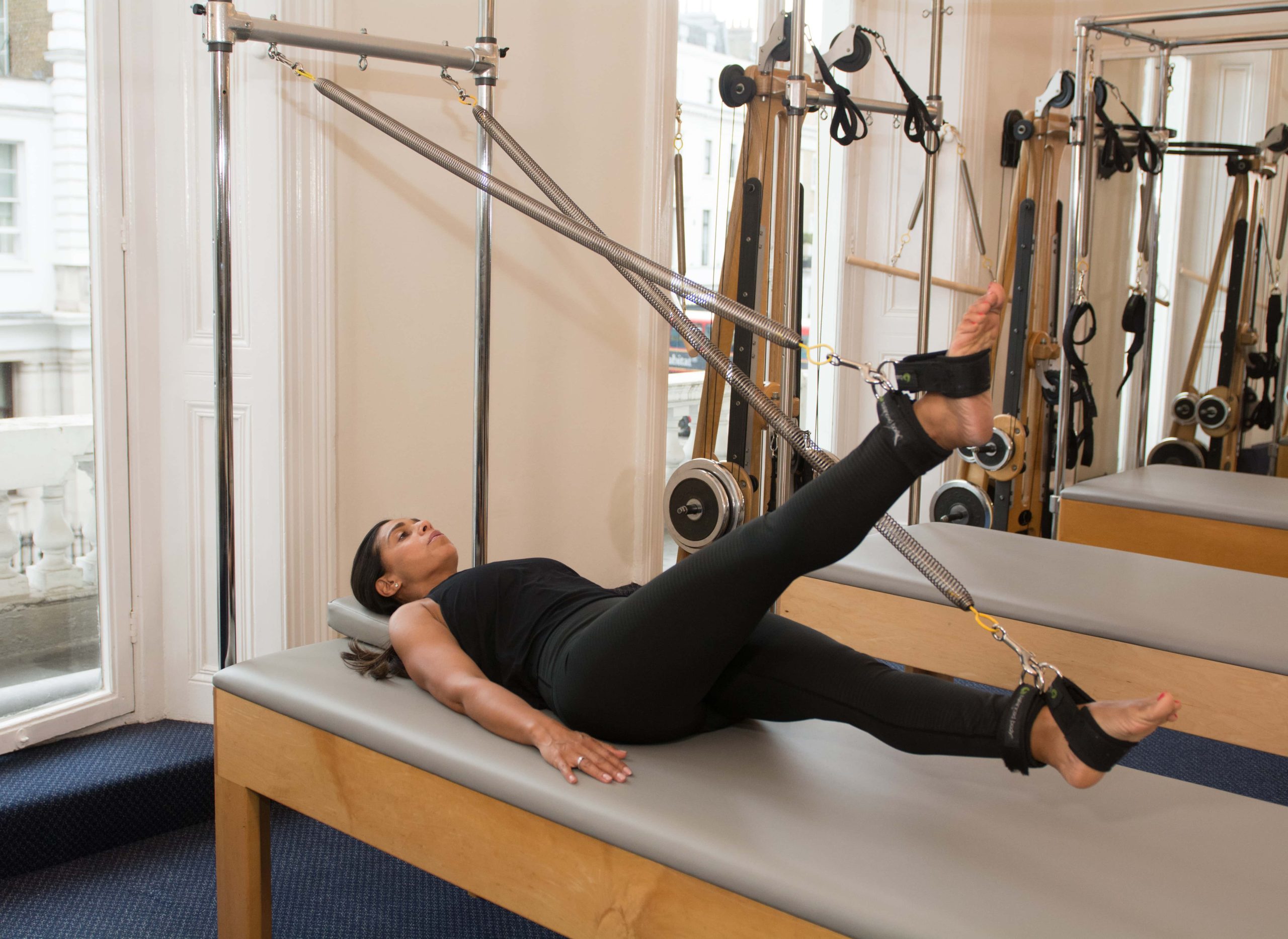
The pilates reformer is a particularly useful tool in post-surgical recovery. The spring resistance system allows for very light loads in the early stages, progressing gradually as strength returns. Many exercises can be done lying down or seated, which reduces loading on the joint while still engaging the necessary muscles effectively.

Reformer pilates for knee replacement is not about working hard — it is about working carefully, building a foundation that allows the new joint to function as it should.

Pilates exercises for knee replacement: what to do and what to avoid

What to focus on in the early stages

In the early phases, the priorities are gentle activation, circulation, and beginning to reconnect with the muscles around the joint. Foot and ankle work, gentle supine leg movements, and hip activation exercises form the foundation. Everything is adapted to the individual — there is no standard programme that applies to every client.

Breathing is also part of this. Deep, coordinated breathing reduces muscular tension, calms the nervous system, and supports the healing process. It is rarely discussed in the context of knee rehabilitation, but it matters.

Pilates exercises to avoid after knee replacement

Certain movements should be avoided following knee replacement surgery — either temporarily or indefinitely, depending on your implant and your surgeon’s guidance. As a general rule, these include:

  • Deep knee flexion beyond the range specified by your surgical team
  • Full squats and deep lunges
  • High-impact movements of any kind
  • Exercises that place rotational force through the knee joint

It is also worth noting that kneeling — even when technically safe — is often uncomfortable after knee replacement, sometimes for a long time. Scar tissue and changes in nerve distribution around the joint can make direct pressure on the prosthetic area feel extremely sensitive. This is not unusual, and it does not mean something is wrong. At Trevor Blount Pilates, any exercise that involves kneeling is either adapted to a different position or done with appropriate padding and support. If kneeling exercises have been putting you off trying pilates after surgery, that is not a barrier here.

A pilates instructor experienced in post-surgical rehabilitation will know which movements to avoid, which to modify, and when to begin reintroducing them. If you are working with someone without that background, the risk of doing something contraindicated increases significantly.

Pilates modifications for knee replacement

Almost every pilates exercise can be modified to be safe and appropriate after knee replacement. Foot bar positions on the reformer can be adjusted, range of motion limited, resistance reduced, and body position changed to unload the joint. The advantage of one-to-one pilates is that every modification is made in real time, based on what you are experiencing in the session.

What to expect at Trevor Blount Pilates

Trevor Blount has over 40 years of experience working with clients recovering from surgery, including hip and knee replacements. Post-surgical rehabilitation is one of the studio’s core areas of expertise.

Every new client begins with an individual assessment — a chance to understand your medical history, your current movement, and what your body needs. From there, the programme is built specifically for you. There is no rushing, no generic protocol, and no assumption that your recovery will follow a set timeline.

Many of our post-surgical clients tell us that what they value most is not feeling pushed — that sessions are genuinely adjusted to where they are on a given day, because recovery is not linear, and a teacher who understands that makes a real difference.

If you are recovering from knee replacement surgery and want to understand whether pilates might help, we would be glad to talk. Get in touch here.

You may also find our post on Pilates for Osteoporosis useful if bone density is part of your wider health picture.

Is Pilates Good for Osteoporosis? What to Know Before You Start

Osteoporosis changes the way you have to think about movement. Not because movement becomes impossible — but because the wrong kind of movement, done without sufficient care, carries real risk. That distinction matters enormously, and it tends to get lost when people are simply told to “stay active.”

Pilates, when taught correctly and adapted to the individual, is one of the most appropriate forms of exercise available to people with osteoporosis. It builds strength without impact, improves posture and balance, and works with the body’s structure rather than against it. But the word “correctly” is doing a lot of work in that sentence. Unsupervised Pilates, or classes that weren’t designed with bone health in mind, can be counterproductive — and in some cases harmful.

This is a question we encounter regularly at our South Kensington studio, and it deserves a careful answer.

Is Pilates Good for Osteoporosis?

Yes — Pilates can be highly beneficial for people with osteoporosis, provided it is taught by an experienced instructor who understands how to modify exercises for reduced bone density. The method supports bone health in several important ways: it loads the spine and long bones through controlled resistance, it strengthens the postural muscles that protect the vertebrae, and it trains balance and proprioception, which reduces the risk of falls.

The key word throughout is supervision. Pilates for osteoporosis is not the same as general fitness Pilates. It requires individual assessment, careful exercise selection, and ongoing adaptation as the client progresses.

Why Pilates Works Well for Bone Health

Is Pilates a Weight-Bearing Exercise for Osteoporosis?

This question comes up often, and the answer is nuanced. Traditional weight-bearing exercise — walking, for example — loads the skeleton through gravity and ground reaction force. Pilates on the apparatus works differently: it uses spring resistance to create load through the muscles and bones without the impact associated with high-intensity activity.

Some apparatus-based exercises, particularly standing work on the reformer or footwork sequences, do involve meaningful skeletal loading. Others, done lying down or seated, are lower-load but still valuable for muscular strength and control. A well-designed programme will include both, calibrated to what the individual’s skeleton can safely tolerate.

Mat Pilates is generally lower-load than apparatus work, which is one reason we work predominantly on the full classical apparatus at our studio. You can read more about how the equipment alters skeletal loading in our guide on Mat Pilates vs Apparatus Pilates. The springs provide graduated, controllable resistance that can be increased incrementally as strength improves.

Posture and Spinal Support

Osteoporosis often leads to a gradual forward rounding of the upper spine — a pattern known as kyphosis — as the vertebrae lose density and begin to compress. Pilates directly addresses the muscular weakness that allows this to develop. Work on the back extensors, the deep spinal stabilisers, and the muscles of the shoulder girdle all contribute to holding the spine in a more upright, supported position.

This is not cosmetic. Improved posture reduces the compressive load on already-vulnerable vertebrae and decreases the risk of fracture over time.

Balance and Fall Prevention

Falls are the primary injury risk for people with osteoporosis, and a significant proportion of Pilates work — particularly on the reformer and the Cadillac — develops the balance, coordination, and proprioception that fall prevention depends on. The controlled, attentive nature of the practice also trains the neuromuscular system: the connection between the brain and the body that governs how quickly and effectively you respond when your balance is challenged.

In our experience, clients with osteoporosis who work consistently over months notice tangible improvements in how steady and confident they feel on their feet. That matters day to day, well beyond the studio.

Can You Do Pilates If You Have Osteoporosis?

Yes, in most cases — but with modifications, and under proper guidance. Osteoporosis is not a contraindication to Pilates. It is a reason to approach Pilates more carefully and selectively than a general fitness client would.

Before beginning, an instructor needs to understand the degree of bone loss, the sites most affected, any history of fracture, and any other conditions that may affect movement. At Trevor Blount Pilates, every new client receives an individual assessment before their first session. For clients with osteoporosis, this assessment is especially important: it shapes every exercise decision that follows.

Which Pilates Exercises to Avoid with Osteoporosis

This is one of the most important practical questions, and the answer is not always obvious from a standard Pilates class.

Exercises that involve strong spinal flexion — rolling through the spine, deep forward bends, curl-up sequences — place compressive load on the front of the vertebral bodies, which is precisely where osteoporotic fractures most commonly occur. This danger is why the Royal Osteoporosis Society recommends modifying or avoiding classical movements like the Roll Down or Rolling Like a Ball in favour of flat-back variations. These movements are appropriate for many people but should be avoided or heavily modified for clients with significant spinal bone loss.

Rotation under load also carries risk, particularly at the thoracic spine, and needs careful management.

High-impact movements, though less common in classical Pilates than in some contemporary reformer classes, are not appropriate.

What remains — and it is a great deal — is a full programme of extension work, lateral movement, standing balance, footwork, and controlled resistance exercise that strengthens the body without loading the spine in vulnerable directions. A skilled instructor will build a programme that is both safe and genuinely challenging.

This is one reason we are cautious about large group reformer classes for clients with osteoporosis. The modifications required are significant enough that they are difficult to deliver safely in a group setting, particularly one moving at pace. We explore this dynamic further in our article on why fast-paced reformer classes can compromise joint and bone safety.

Is Reformer Pilates Good for Osteoporosis?

Reformer Pilates can be excellent for osteoporosis — but again, the teaching context matters enormously. The reformer provides spring-loaded resistance that can be carefully calibrated, and many reformer exercises are naturally well-suited to extension-focused, low-flexion work. Footwork on the reformer, for instance, loads the hip and leg bones through a controlled push, which supports bone density in the lower extremities.

The reformer becomes less appropriate when used in a fast-paced group class format where exercises are not selected or modified with bone health in mind. The same piece of equipment, in two different teaching contexts, can produce very different outcomes for a client with osteoporosis.

At our studio, reformer work sits within a broader programme that also draws on the Cadillac, the Wunda Chair, and other apparatus — chosen for each individual based on what their body needs at that point in their progress.

What to Expect at Trevor Blount Pilates

Trevor Blount has worked with clients with osteoporosis and osteopenia throughout his 40 years of teaching. Several of our instructors have specific experience in this area, and all are trained in the Trevor Blount Method — which begins, always, with individual assessment.

For clients with osteoporosis, sessions are one-to-one. There are no group classes at our studio. Every programme is built around the individual’s specific bone health, physical history, and goals — and it evolves as strength, balance, and confidence develop.

The studio is based in South Kensington and has been running in the same location since 1991. If you are living with osteoporosis or osteopenia and want to understand whether Pilates is right for you, we are glad to talk it through before you commit to anything.

You can find more about our approach on our sessions page or read about how we work with hypermobility and other conditions.

Trevor Blount Pilates is a classical Pilates studio in South Kensington, London. We offer one-to-one sessions for clients with a range of conditions, including osteoporosis, osteopenia, post-surgical rehabilitation, and chronic pain.

Pilates for Back Pain: What to Expect When You Start

Back pain is one of the most common reasons people find their way to our studio. And it is also one of the areas where we see the most significant, lasting change.

But starting Pilates with back pain raises real questions. Will it make things worse? What actually happens in a session? How long before you feel different?

This is what you need to know before you begin.

Pilates can help with back pain — but only when it is taught correctly

The core principle behind the Trevor Blount method is that every body is different, even when the symptoms look the same. Two people can walk in with lower back pain and have completely different causes behind it — one a structural imbalance, one a history of disc compression, one a pattern of overusing the wrong muscles for years.

That is why a generic class is rarely the right starting point. What helps one person can aggravate another.

Does Pilates help with lower back pain?

Yes — when it is assessed, structured, and progressed correctly. Pilates trains the deep stabilising muscles that support the spine, reduces compression on the joints, and improves the symmetry of how you move. Over time, this takes pressure off the structures that are causing pain.

The key word is “over time.” Pilates is not a quick fix. But for people with chronic or recurring back pain, it tends to produce changes that hold — because it addresses how the body moves, not just how it feels on a given day.

What to expect in your first session

The first session at Trevor Blount Pilates is always an individual assessment. We do not put a new client straight onto the apparatus and begin a programme. We look first.

We are looking at your posture, your range of movement, where you are holding tension, and what your body is doing to compensate for the pain. Forty years of working with people in pain means Trevor and his teachers have seen most patterns before. Often we can identify the mechanical cause quite quickly.

From there, your programme is built specifically for you. The exercises, the resistance, the pace — all of it is matched to what your body needs at that point.

Is Pilates safe if I have a slipped disc or sciatica?

In most cases, yes — but only with proper assessment and guidance. The classical apparatus is particularly well suited to disc-related conditions because the supported, horizontal positions reduce spinal loading while still allowing you to build the deep muscle control that protects the spine.

We work closely with physiotherapists and orthopaedic consultants, and many of our clients come to us on medical referral. If you are managing a specific diagnosis, we will always work within the parameters your medical team has set.

Why group classes are often the wrong starting point for back pain

If you are in pain, a group reformer class — however well intentioned — puts you in a room where the teacher cannot adjust the session for your specific mechanics. The pace is set for the group. The cues are general. And if something is not right for your body, you may not know until after the session.

This is not a criticism of group Pilates for healthy, pain-free people. But clinical Pilates and fitness Pilates serve different purposes. When back pain is involved, the clinical approach — individual assessment, tailored programming, a teacher who is watching only you — is what produces reliable results.

How many sessions before I notice a difference?

Most clients notice something shifting within four to six sessions — better posture awareness, less tension through the lower back, movement that feels less effortful. Significant structural change takes longer, typically three to six months of consistent work.

How often you come makes a meaningful difference. Once a week is a reasonable start. Twice a week, where possible, tends to accelerate progress considerably.

The clients we see

Over forty years, the back pain cases that have come through this studio cover almost every category: herniated discs, scoliosis, post-surgical recovery, chronic postural pain from desk work, sports injuries that were never quite resolved.

One client came to us unable to get out of bed during acute episodes. Trevor designed a programme to strengthen the muscles that had wasted without irritating the spine — and after consistent work, she had not had a severe episode in years. She no longer used the specialist back chair she had relied on for years.

These are not unusual outcomes. They are what happens when the work is appropriate and the progression is careful.

Starting Pilates for back pain in London

Our studio is in South Kensington, a short distance from Kensington, Knightsbridge, and Chelsea. If you are considering Pilates for back pain and want to understand whether it is the right approach for your situation, the best starting point is a conversation.

View session options and pricing or call us on +44 20 7584 0680.

Find us on Intently